Home

Sök


Header (Main)
Bransch
Rörlighet Rörlighet
Fordonsindustrin
Driving The Future Of SDV

Vi banar väg för SDV:s framtid

Explore
Flyg- och rymdindustrin
AI-Enabled Aircraft Health Monitoring for Predictive Maintenance

AI-baserad övervakning av flygplanets skick för förebyggande underhåll

Explore
Järnväg
Engineering Next-Gen Rail Mobility

Utveckling av nästa generations järnvägstransporter

Explore
Närings- och fritidsfordon
Reinventing the Recreational Vehicle

Att förnya fritidsfordonet

Explore
Terrängfordon
Off-highway Vehicles and Machines

Terrängfordon och terrängmaskiner

Explore
AI in Mobility

Artificiell intelligens inom mobilitet

Explore
Hållbarhet Hållbarhet
Diskret tillverkning och industriprodukter
Byggteknik och smart infrastruktur
Elförsörjning och styrsystem
Industrimaskiner
LTTSGridEyeTM

LTTSGridEye™

Explore
Processindustri
Olja och gas
Kemikalier
FMCG
ISG: Oil & Gas Industry Services and Solutions – AI and Cloud – Americas

Marknadsledare enligt ISG Provider Lens™: Olje- och gasindustrin – AI och molntjänster – Nordamerika

Explore
L&T Technology Services, Siemens Partner for AI-led Transformation in Process Engineering & Smart Manufacturing

LTTS och Siemens ingår partnerskap för AI-driven omställning inom processteknik och smart tillverkning

Explore
Teknik Teknik
Datacenter
LTTS Data Center Services - From the Chip to the Grid!

LTTS datacentertjänster – Från chip till elnät!

Explore
HiTech
Konsumentelektronik
Media och underhållning
NexGen Comms
Halvledare
Automated Ad Integration and Delivery Validation

Automatiserad annonsintegration och validering av leverans

Explore
MedTech
L&T Technology Services Transforms Respiratory Diagnostics with NVIDIA AI-Powered Digital Twin Technology

LTTS revolutionerar diagnostiken inom andningsvägarna med NVIDIA:s AI-drivna digitala tvillingteknik

Explore
Offentlig infrastruktur och smarta städer
Integrated Smart Surveillance Project

Integrated Smart Surveillance Project

Explore
Programvara och plattformar
LTTS & SymphonyAI to provide AI-based transformation

LTTS och SymphonyAI ska genomföra en AI-baserad omställning

Explore
Unlocking PLxAI with Alind Saxena

En djupdykning i PlxAI tillsammans med Alind Saxena

Explore
Upptäck våra lösningar Upptäck våra lösningar
Tjänster
Digital teknik och rådgivning Digital teknik och rådgivning
Artificiell intelligens
Cybersäker
Säkerhetsövervakning
Säkerhetsoperationscentralen
Säkerhetstjänster
Säkerhetslösningar
Fängslande upplevelser
Industri 4.0
Private Equity
Produktrådgivning
Hållbarhetsteknik
En hållbar och smart värld
5G
Pragmatic by Design: Engineering AI for the Real World

Pragmatisk design: Utveckling av AI för den verkliga världen

Explore
Produktutveckling Produktutveckling
Programvaruutveckling
Molnteknik
DevOps
Teknisk analys
Fängslande upplevelser
Föda och underhåll
Användarupplevelse
Röstinnovationer
Inbyggd teknik
Inbyggda system
Näring
VLSI
Teknik för bärbara enheter
Mekanisk konstruktion
CAE och CFD
CAx-automatisering
Testning och validering
Integrerad konstruktion, validering och testning
Lab som tjänst
Testning
ISG: Automotive and Mobility Services and Solutions – Automotive Engineering and Manufacturing Services – North America

Marknadsledare enligt ISG Provider Lens™: Tjänster och lösningar inom fordons- och mobilitetsbranschen – Nordamerika

Explore
Tillverkningsteknik Tillverkningsteknik
Smart tillverkning
Anläggningskonstruktion och teknik
Digital fabrik och simuleringar
Effektiverade verksamheter
Logistikteknik
Inköp och upphandling
Tillverkning och planering
Effektiverade verksamheter
Digital fabrik och simuleringar
Linjeutbyggnad och överföring
Automatisering inom tillverkningsindustrin
Utveckling av nya produkter
Anläggningskonstruktion och teknik
PLM i molnet
Produktionsstyrning
Agile leveranskedja
Innehållsutveckling
Material- och komponenthantering
Inköp och upphandling
L&T Technology Services Transforms Respiratory Diagnostics with NVIDIA AI-Powered Digital Twin Technology

LTTS revolutionerar diagnostiken inom andningsvägarna med NVIDIA:s AI-drivna digitala tvillingteknik

Explore
Anläggningsteknik Anläggningsteknik
CAPEX-projekt – E/EPCM-tjänster
Operativ excellens
Växtvård och skötsel
Material- och komponenthantering
Teknik för efterlevnad av regelverk
ISG: Oil & Gas Industry Services and Solutions – AI and Cloud – Americas

Marknadsledare enligt ISG Provider Lens™: Olje- och gasindustrin – AI och molntjänster – Nordamerika

Explore
Upptäck våra lösningar Upptäck våra lösningar
Lösningar
AiCE
AiKno®
AnnotAI
ARC
Ramverk för tillgångars skick
CHEST-rAi™
Uppkopplad säkerhet
EDGYneer
ESM
EvQUAL
FlyBoard®
Fusion
i-BEMS
Nliten
nBOn
PSM
SafeX
IP för halvledare
Lösning för sensorer och gateways
UBIQWeise 2.0
Insikter
Analytikerrapporter
Bloggar
Broschyrer
Fallstudier
E-böcker
Evenemang
Podcasts
Perspektiv
Videor
Webbseminarier
Vitböcker
Karriär
Om oss
Utmärkelser
Allianser
Analytiker
Styrelsen
CSR
Engineer At Heart
Att driva Engineering the change
Innovationer
Investerare
Nearshore-centra
Nyheter och media
Kvalitetsledning
Hållbarhet inom företaget
Kundutlåtanden
Kontakt
Header (Secondary)
Sök
E-post
  • English
  • Deutsch
  • 日本語
  • Svenska
Kontakt

Breadcrumb

  1. Blogs
  2. Industry
  3. From Assistance to Autonomy: How Medical Robots and Humanoids are Quietly Rewriting Care

From Assistance to Autonomy: How Medical Robots and Humanoids are Quietly Rewriting Care

Rupam Chaudhury
Rupam Chaudhury

Global Segment Head - MedTech

MedTech

Published on 24 Apr 2026

min read

263

Views

ltts

It is 3 a.m. on the medical floor – but the hospital is anything but asleep. 

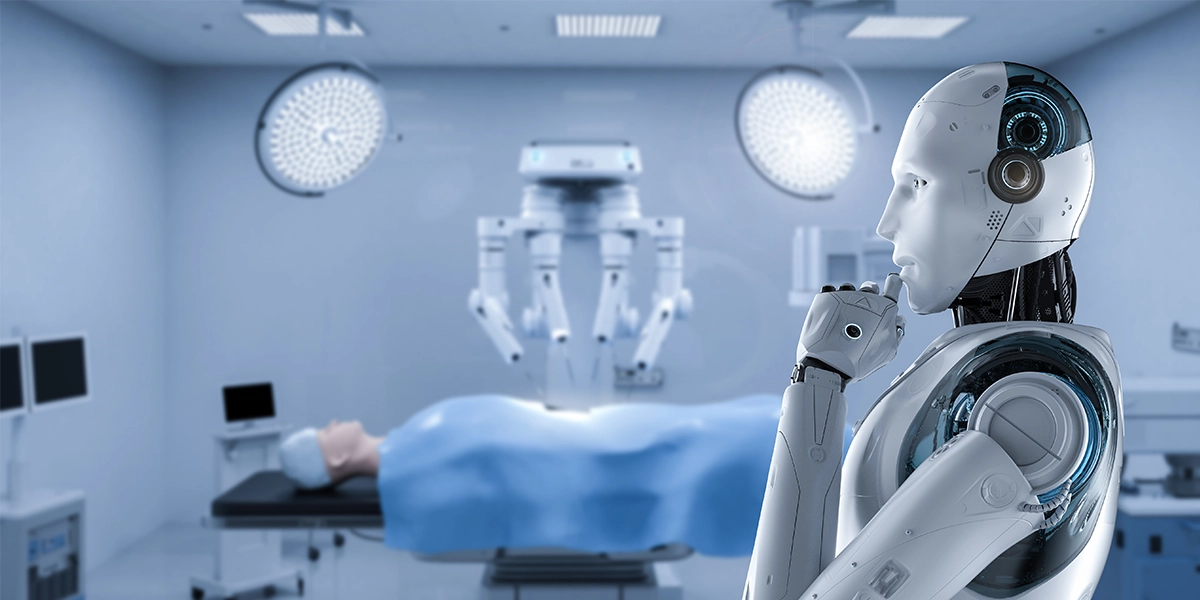
A wheeled robot glides through secured corridors carrying medications and lab specimens, doors opening automatically as it passes. Down the hall, a UV disinfection unit completes its self-set cycle, logging another reduction in environmental bioburden. And in the operating room next door, a soft-tissue surgical robot helps the team navigate fluorescence-marked anatomy with millimeter precision, with peri-operative data being captured for the morning’s quality review.

Science fiction? No – just a state-of-the-art hospital in operation.

Once positioned as premium add-ons or innovation pilots, robotics and early humanoid systems are quietly shifting into hospital operational infrastructure. This now is about reliability, safety, and scale.

The Big Picture: From Specialized Arms to System-Level Autonomy

A decade ago, “robots in healthcare” was shorthand for robotic surgery, primarily, articulated arms deployed in a limited number of high-end operating rooms. Those systems proved that precision, consistency, and ergonomics matter. 

But their success also set expectations that robotics could do more than just assist surgeons.

Today, the footprint is far broader. Robots now span surgery, logistics, pharmacy operations, environmental services, rehabilitation, telepresence, and elder care. Autonomous mobile robots handle what clinicians often call the “last mile” of hospital work, across transporting supplies, specimens, linens, and waste – critical tasks that are rarely visible.

The timing is not accidental, with health systems facing a convergence of pressures across:

  • Aging populations with rising chronic disease burdens,
  • Persistent staffing shortages and clinician burnout,
  • Strong patient and provider preference for minimally invasive surgery, and
  • Maturing AI, connectivity (5G), IoT, and real-time data platforms.

Market analysts estimate medical service robots growing at roughly 16–17% CAGR, reaching ~$50B+ by 2030. But the real story is not the revenue curve, but rather, the ongoing operational shift – fewer delays, lower infections, lesser wasted steps, and a drop in exhausted clinicians at the end of a long shift.

What’s Changing Now: From “Latest and Greatest” to Clinically Normal

Soft-Tissue Surgical Robotics Enters a New Phase

Soft-tissue surgical robotics is no longer a single-vendor story. While pioneers like Intuitive Surgical established the category, recent U.S. regulatory clearances and first-in-human trials (2024–2025) have expanded the field, particularly in urology and general surgery.

This competition is reshaping design priorities. Newer platforms emphasize modular architectures, fluorescence-guided visualization, open or semi-open consoles that improve team communication, and deeper integration with peri-operative analytics. Surgeons increasingly expect systems that fit into data-driven quality improvement workflows, and not just tools that move instruments.

Orthopedic Robotics Scales with Data at the Core

Orthopedic robotics has moved decisively into the mainstream. While knee and hip replacements were the initial proving ground, shoulder and other joint applications are now gaining traction. Companies such as Stryker and Zimmer Biomet have expanded systems that support personalized alignment, kinematic planning, and intra-operative data capture.

Robotics is, therefore, becoming less about rigid pre-operative plans and more about adaptive execution. Surgeons are leveraging real-time data to balance alignment, soft-tissue tension, and patient-specific anatomy, improving reproducibility while reducing physical strain in the OR.

Cardiovascular Robotics Builds a Cautious Evidence Base

Robotic percutaneous coronary intervention (PCI) remains a smaller segment, but the evidence base is maturing. Large registries and comparative studies have shown high procedural success, reduced operator radiation exposure, and one-year outcomes comparable to manual PCI. 

While manual assistance is still required in select cases, it is already evident that robotics can meaningfully improve operator safety without compromising patient outcomes.

Here, progress has been deliberately conservative. Cardiovascular robotics illustrates how autonomy in healthcare must grow in step with clinical evidence and case selection discipline.

The Quiet Revolution in Hospital Operations

If surgical robotics is the visible face of automation, hospital operations are where the quiet revolution is unfolding.

Autonomous mobile robots are now routine in many large hospitals, handling medication delivery, specimen transport, and supply movement. Systems deployed by companies like Aethon and Swisslog integrate directly with inventory and pharmacy platforms, enabling closed-loop traceability and measurable staff time savings.

UV disinfection robots, deployed in systems like those from Xenex, are increasingly used as complements to manual cleaning, not replacements. Studies published during and after the COVID-19 pandemic showed reductions in certain healthcare-associated infections when these systems were used with disciplined protocols.

What is notable is how little attention these robots attract once deployed. And when they work reliably, they fade into the background, exactly what infrastructure is supposed to do.

Telepresence and the Human Side of Robotics

Telepresence robots, once dismissed as awkward tablets on wheels, have matured significantly. In emergency departments and long-term care facilities, peer-reviewed studies have shown reductions in caregiver burden, faster specialist access, and improved continuity during virtual rounds.

Design matters here. 

Successful deployments prioritize safety, predictable movement, and respectful human-robot interaction. The lesson is clear that in healthcare, social engineering matters as much as technical engineering.

Humanoids: Measured Progress, Not Hype

Humanoid robots generate outsized attention, and perhaps equally large volumes of skepticism. Recent studies underscore that teleoperated humanoids can perform selected dexterous tasks, including ventilation assistance and ultrasound-guided actions. At the same time, these studies also document certain limitations in force control, tactile sensing, and reliability.

Independent experts consistently stress the need for standards, fail-safes, and staged deployment. This is not a domain for risky shortcuts.

Interestingly, some of the most successful “humanoid-adjacent” systems do not walk at all. Wheeled platforms like Diligent Robotics’ Moxi focus on human-scale manipulation without legs, an intentional choice that prioritizes stability, safety, and uptime. These systems are already delivering measurable ROI by offloading routine tasks from nurses and technicians.

Legged humanoids continue to advance, particularly in teleoperation and controlled environments, but routine patient-facing deployment remains a future milestone rather than a present reality.

Let Robots Lift the Load – Let Clinicians Lead the Healing

Robots and humanoids are not here to replace clinicians. They are here to absorb the friction – physical, cognitive, and logistical – that pulls skilled professionals away from patient care.

The organizations that succeed will not be the ones that chase autonomy for its own sake, but those that run disciplined pilots, invest in training and safety, and scale what proves its value. The technology curves are impressive. 

But the real payoff is human: safer surgeries, faster recovery, fewer infections, and less burnout.

Afterall, healthcare does not need a spectacle, but rather, systems that can show up at 3 a.m. and work toward saving lives.

Relevant Blogs

Embedded Engineering Excellence: A Cross-Industry Perspective
First-time-right: Balancing Speed With Clinical Validation
DevOps in the Healthcare Industry: Ensuring Quality, Security, and Safety
Explore All

Håll kontakten med oss

Prenumerera på vår blogg

Rupam Chaudhury
Rupam Chaudhury

Global Segment Head - MedTech

Rupam brings decades of experience across R&D, Product Development, Manufacturing Engineering, Quality, Regulatory, and Connected Care systems within the Medical Devices, Life Sciences, and Healthcare sectors. Over the past 25 years, he has led pioneering client relationships, therapeutic programs, and award‑winning innovations. Rupam played a foundational role in shaping the Medical Devices business within the erstwhile Engineering Services unit and has driven industry‑specific solutions spanning clinical intelligence, image and video analytics, SaMD, robotics, AI, and GenAI. He also holds multiple patents earned over the course of his career.

Footer Navigation
  • Bransch
    • Rörlighet
      • Flyg- och rymdindustrin
      • Fordonsindustrin
      • Järnväg
      • Lastbilar och terrängfordon
    • Hållbarhet
      • Diskret tillverkning och industriprodukter
      • Processindustri
    • Teknik
      • Datacenter
      • Konsumentelektronik
      • MedTech
      • Media och underhållning
      • NexGen Comms
      • Halvledare
      • Programvara och plattformar
      • Offentlig infrastruktur och smarta städer
  • Tjänster
    • Digital teknik
      • Artificiell intelligens
      • Cybersäker
      • Säkerhetsövervakning
      • Säkerhetslösningar
      • Säkerhetstjänster
      • Fängslande upplevelser
      • Industri 4.0
      • Private Equity
      • Produktrådgivning
      • Hållbarhetsteknik
      • En hållbar och smart värld
      • 5G
    • Produktutveckling
      • CAE och CFD
      • CAx-automatisering
      • Programvaruutveckling
      • Molnteknik
      • DevOps
      • Inbyggda system
      • Teknisk analys
      • Integrerad konstruktion, validering och testning
      • Lab som tjänst
      • Näring
      • Testning
      • Testning och validering
      • Användarupplevelse
      • VLSI
      • Röstinnovationer
      • Teknik för bärbara enheter
    • Tillverkningsteknik
      • Effektiverade verksamheter
      • Agile leveranskedja
      • Innehållsutveckling
      • Digital fabrik och simuleringar
      • Linjeutbyggnad och överföring
      • Automatisering inom tillverkningsindustrin
      • Utveckling av nya produkter
      • PLM i molnet
      • Anläggningskonstruktion och teknik
      • Inköp och upphandling
    • Anläggningsteknik
      • CAPEX-projekt – E/EPCM-tjänster
      • Material- och komponenthantering
      • Operativ excellens
      • Växtvård och skötsel
      • Inköp och upphandling
      • Teknik för efterlevnad av regelverk
  • Att driva Engineering the change
  • Karriär
  • Engineer At Heart
  • Resurser
  • Lösningar
    • AiCE
    • AiKno®
    • AnnotAI
    • ARC
    • Ramverk för tillgångars skick
    • CHEST-rAi™
    • Uppkopplad säkerhet
    • EDGYneer
    • ESM
    • EvQUAL
    • FlyBoard®
    • Fusion
    • i-BEMS
    • LTTSiDriVe™
    • Nliten
    • nBOn
    • PLxAI
    • PSM
    • SafeX
    • IP för halvledare
    • Lösning för sensorer och gateways
    • UBIQWeise 2.0
    • TrackEi™
  • Om oss
    • Utmärkelser
    • Allianser
    • Bloggar
    • Styrelsen
    • CSR
    • Evenemang och webbseminarier
    • Innovationer
    • Investerare
    • Mediepaket
    • Nearshore-centra
    • Nyheter och media
    • Kvalitetsledning
    • Hållbarhet inom företaget
    • Kundutlåtanden
LTTS
  •  Twitter
  •  LinkedIn
  •  YouTube
  •  Facebook
  •  Instagram
  • Upphovsrätt och villkor
  • Sekretess
  • Sitemap
  • info@ltts.com

© 2026 L&T Technology Services Limited. All Rights Reserved.