Published on 24 Jul 2026
min read
Views
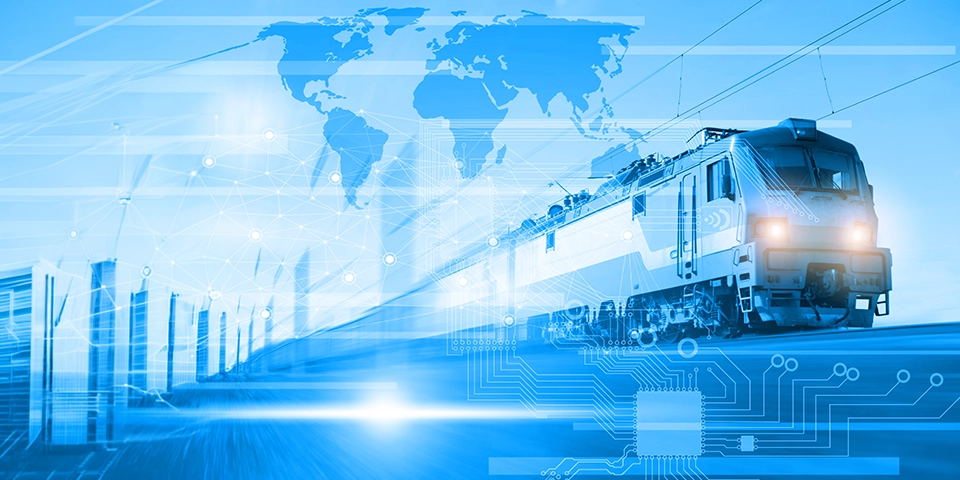
At 5:00 AM, before the first train departs, a modern railway network is already in motion – but not just physically. Sensors embedded across tracks, rolling stock, and signaling systems are streaming real-time data; control centers are simulating traffic flows before congestion occurs; and algorithms are predicting component failures days in advance.
This is what digital railway transformation looks like in practice.
The railroads are no longer just a physical network of tracks, trains, stations, and signaling assets but, increasingly, a real-time intelligence system that monitors conditions, anticipate failures, optimize capacity, and support safer decisions across the operating lifecycle. This is the next era of railway digitalization: a shift from digitizing individual assets to engineering predictive, adaptive, and data-led rail ecosystems.
The Industry Inflection Point: Rising Demand and Complexities
Railways worldwide are under unprecedented pressure to transform.
Amidst a rapid rise in passenger demand, growing freight volumes, and a global push toward lower-carbon transport, most rail networks continue to run on legacy infrastructure, fragmented systems, and vendor-specific platforms that are difficult to scale. Industry investment in digital rail, as result, continues to grow – driven by smart railway infrastructure, predictive maintenance, intelligent fleet systems, and advanced signaling – with estimates putting the market at close to $91 billion.
At the same time, railways operators are navigating multiple industry challenges, including:
- Aging infrastructure with limited upgrade flexibility,
- Fragmented data across IT and OT systems,
- Interoperability challenges across regions and vendors,
- Rising safety, compliance, and cybersecurity requirements,
- Pressure to deliver higher capacity without expanding physical assets. and
- A widening skills gap in managing AI-led, data-driven systems.
Together, these forces are pushing the industry toward a tipping point – railways worldwide need to deliver higher safety, capacity, reliability, and sustainability without relying solely on large-scale physical expansion. However, we need to remember that digital adoption in rail has historically moved slower than in other industries – held back by data quality limitations, a lack of standardization, and complex regulatory environments.
From Railway Digitalization to Intelligent Railway Systems
The first wave of railway digitalization focused on visibility, automation, and control-room efficiency. The current wave is more ambitious. Data is no longer collected only for reporting – it is used to predict asset behavior, optimize operations, support autonomous decision-making, and continuously improve system performance.
This evolution is being shaped by several technology shifts, including:
- AI in railways, powering predictive analytics and decision-making,
- IoT in railways, enabling real-time monitoring across network assets,
- Digital twin in railways, supporting simulation and lifecycle optimization,
- A shift toward autonomous train operations and advanced signaling, and
- Integration of energy-efficient, sustainable rail ecosystems.
Together, these technologies form the foundation of intelligent railway systems, where infrastructure, rolling stock, control systems, and enterprise platforms operate as part of a common intelligence layer.
Smart Railway Infrastructure: Increasing Capacity Without Expanding Footprint
Rail infrastructure, increasingly, is moving from static assets to instrumented, connected, software-enabled systems. Digital signaling technologies such as ETCS and CBTC enable real-time train control, optimized headways, higher route utilization, and improved operational safety. By allowing trains to run closer together under controlled conditions, these systems increase network capacity without a proportionate expansion of physical infrastructure.
Alongside this, intelligent rolling stock and connected ecosystems are reshaping day-to-day operations across:
- Real-time diagnostics and remote monitoring
- Data-driven traffic and scheduling optimization
- Improved passenger experience through digital services
- Energy optimization for sustainable operations
The value of smart railway infrastructure is practical and immediate across better asset visibility, faster operational response, improved service reliability, and higher throughput on constrained networks.
Railway Predictive Maintenance: From Scheduled Intervention to Intelligent Resilience
Railway predictive maintenance is one of the clearest business outcomes of digital rail investment. Traditional maintenance models rely on fixed schedules, periodic inspections, and reactive interventions. These methods are necessary, but they can miss early-stage degradation, create avoidable downtime, and add to lifecycle cost. With AI-enabled analytics and IoT-based monitoring, operators can shift toward condition-based maintenance models that support:
- Continuous, real-time asset monitoring
- Early detection of hidden defects
- Optimized maintenance planning
- Reduced downtime and lifecycle costs
In practice, vibration signatures can flag early bearing degradation, thermal patterns can reveal electrical or mechanical stress, and image analytics can support early detection of defects in track, overhead equipment, or rolling stock.
The impact goes beyond maintenance efficiency. Early detection helps reduce safety risks, improves asset availability, protects revenue, and gives operators the time to plan interventions before failures affect critical service.
Digital Twin in Railways: Real-Time Intelligence Across the Network
Digital twin technology today connects physical rail assets with virtual models that mirror their condition, performance, and operational context. By creating real-time representations of infrastructure, rolling stock, depots, stations, or corridors, digital twin in railways applications enable the simulation of operational scenarios, drive predictive failure analysis, ensure network-wide optimization, and facilitate improved decision-making.
Integrated with IoT, AI, and analytics, these models let operators test scenarios, compare intervention strategies, and refine decisions before changes are applied to the live network. Scaling these capabilities, however, can introduce new challenges across:
- Data integration across legacy systems,
- High implementation complexity,
- Cybersecurity vulnerabilities, and
- The need for standardized frameworks.
Railway Cybersecurity: Securing the Connected Rail Ecosystem
As railways become more connected, railway cybersecurity becomes a core engineering requirement rather than a separate compliance activity.
The convergence of IT and OT systems expands the attack surface across signaling, control centers, communication networks, onboard systems, depots, and cloud-connected applications. As real-time data exchange and remote operations increase, cybersecurity must protect both operational continuity and passenger safety.
A mature approach calls for secure-by-design architecture, asset visibility, continuous threat monitoring, identity and access control, incident response readiness, and governance aligned with the safety-critical nature of rail operations.
From Digital Transformation to Engineering Intelligence
We feel that the future of rail will be defined by Engineering Intelligence: the ability of railway systems to sense real-time conditions, analyze data across assets, recommend or automate decisions, and continuously learn from operational outcomes. For railway leaders, this would include a commitment to build networks that are safer, more reliable, more capacity-efficient, and more sustainable. And treating digital railway transformation not as a technology program, but as a long-term engineering strategy for smarter rail operations will be key to the journey.
All aboard?