


Lung Digital Twin
Inside every lung is a map no one can fully see – a thousand branching airways, vessels threaded between them, and somewhere in the maze, a nodule the width of a grain of rice. From one lung CT scan, LTTS builds an AI digital twin that sees its anatomy, diagnoses what matters, and navigates the route in, so the device sent to find it no longer goes in blind.
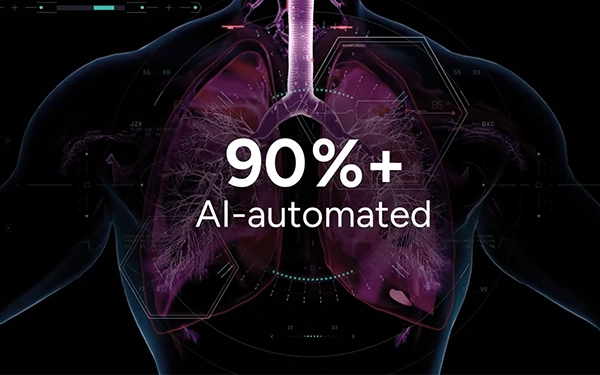
The LTTS Lung Digital Twin
The Device Goes in Almost Blind
A bronchoscope threads a maze of airways toward a target millimetres wide, with limited spatial context and vessels it cannot see. The intelligence that would let it navigate with certainty is the hardest part of the device to build, and the slowest to clear.
Navigating blind
Lung navigation devices enter a branching maze of airways with little forward view of the optimal path or the vessels nearby

The data problem
Medical AI is starved of large, diverse, annotated datasets – and manual annotation is slow, costly, and hard to scale

Proving the AI
Regulators and clinicians now expect device makers to show how an AI model reached its conclusion, not just the output

Build vs. buy
Building organ intelligence in-house takes years and deep specialist teams, delaying the device's route to market

The result: the layer that would set your device apart is the one your team can least afford to build from scratch.
Feature Highlights
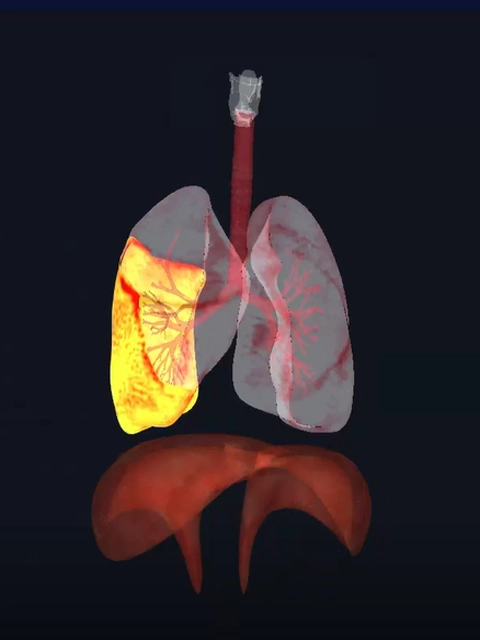
- Auto-segments airways, vessels, and the five lobes into a 3D reconstruction with an anatomical reference baseline
- AI-automated with no need for manual annotation
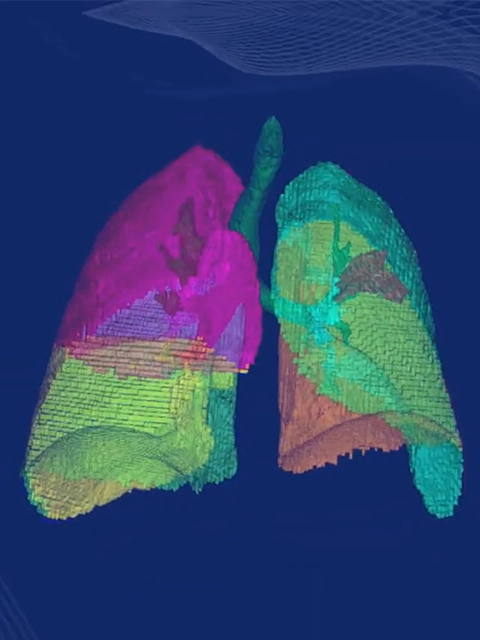
- Detects and localizes tumors, fibrosis, emphysema, and obstruction
- Measurement and quantification (airway diameter, volumetrics)
- Risk assessment
- Explainable AI
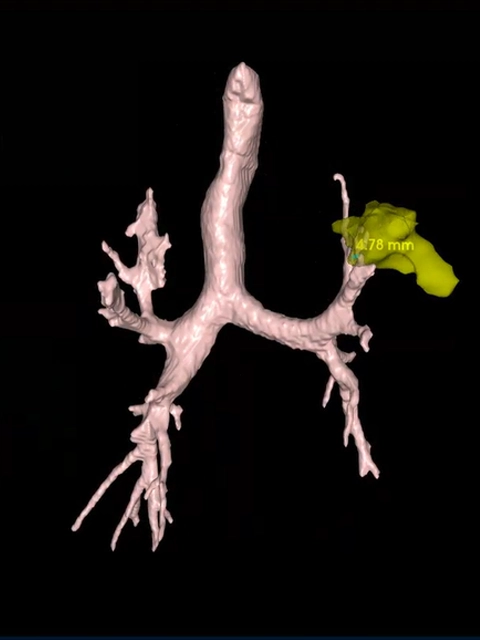
- Virtual bronchoscopy navigation
- Optimal scope path
- Vessel-proximity mapping
- Branch-by-branch guidance
- Pre-procedural planning
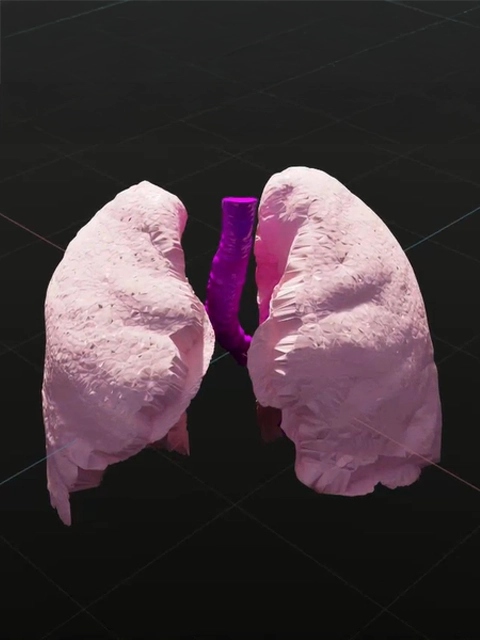
- Airflow and tissue-mechanics simulation via CFD
- Disease-progression, treatment-response and outcome forecasting
- What-if scenarios run virtually

- Multi-planar and 3D rendering
- Quantitative measurement
- Tumor-growth progression analysis and monitoring
Tell Us What You’re Looking For in Lung Digital Twin
Handpicked for You
Track Record & Proof
Built on LTTS Engineering Intelligence, the lung twin was engineered with practicing pulmonologists and surgeons, grounding the model in real clinical workflows rather than a research prototype. Built today, extensible tomorrow. The structural, diagnostic, and procedural twins are built and demonstrable for the lung. A behavioral twin is part of the roadmap, with the same framework is designed to extend across organs.
Proof points
- Patented navigation method — “Method and system for guiding navigation of an imaging tool”
- 90%+ AI-automated segmentation, with no manual annotation
- Built with practicing pulmonologists and surgeons
- Trained on diverse, multi-source clinical data
- Reusable framework: lung today; liver, heart, brain and eye on the roadmap

Where the Twin Earns Its Place


What the twin does
Maps the optimal scope path and vessel proximity from the scan before the procedure begins.

Outcome
Navigate with a plan

What the twin does
Embeds navigation and diagnostic intelligence into a bronchoscopy or endoscopy platform.
Outcome
A differentiated device

What the twin does
Provides a precise anatomical baseline so models need fewer massive, costly annotated datasets.
Outcome
Less data dependency

What the twin does
Shows how each AI conclusion was reached with a plain-language, heat-map rationale.
Outcome
Transparency & trust

What the twin does
Quantifies and tracks nodule and tumour growth across successive scans.
Outcome
Measurable progression

What the twin does
Reuses the same framework to build twins for the liver, heart, brain and eye.
Outcome
One platform, whole roadmap
- Faster to market: Up to 50% faster to market than building the organ-intelligence layer in-house - you start from a working, patented twin, not a blank sheet.
- Lower data burden: 90%+ automated segmentation cuts the dependence on massive, costly annotated datasets.
- Differentiation: Navigation and explainability become the layer that sets your device apart.
- Regulatory readiness: Explainable AI supplies the transparency case regulators and clinicians now expect.
- Scale across organs: One reusable framework: lung today; liver, heart, brain and eye next.
- Protected Solution: The navigation method at the core of the twin is patented.
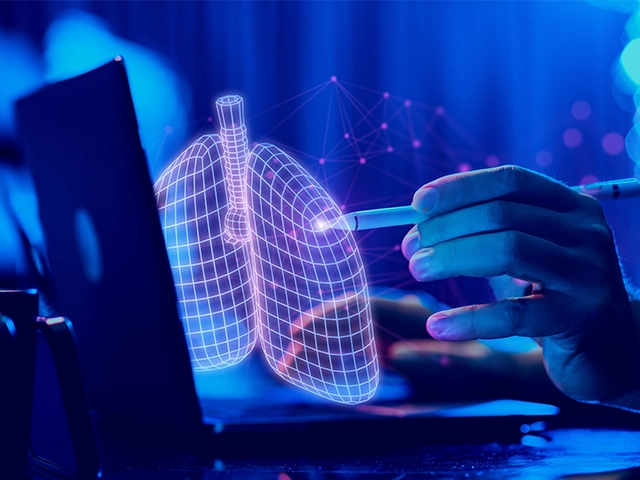
The Intelligence Inside Your Next Device
One scan. One living twin. Structural, diagnostic and procedural today - behavioral on the roadmap, and a framework that scales across organs.
Resources
LTTS’ Lung Digital Twin
LTTS' Lung Digital Twin turns one CT scan into four layers of intelligence - Structural, Diagnostic, Procedural, and Behavioural - for precision pulmonary care.
The LTTS Lung Digital Twin
A bronchoscope threading a thousand airways toward a nodule the size of a rice grain — with vessels it can't see. That's the hardest problem in medical AI. Here's how we solved it.
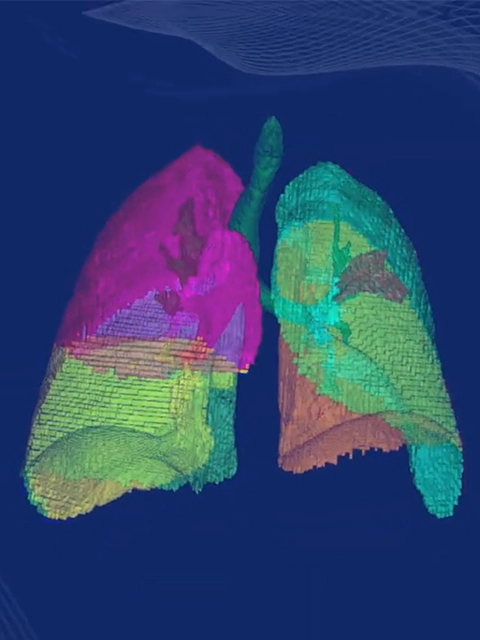
A lung digital twin is an AI-generated virtual replica of a patient's lung, reconstructed from medical imaging such as a CT scan. It maps the airways, blood vessels and lobes in three dimensions, so clinicians and medical devices can visualize, analyze and navigate the lung's real anatomy before a procedure begins. The LTTS Lung Digital Twin builds this replica from a single CT scan and layers diagnostic and navigation intelligence on top of it.
A lung digital twin improves bronchoscopy by replacing guesswork with a planned route. Today a bronchoscope navigates a maze of a thousand airways toward a target millimetres wide, with limited spatial context and vessels it cannot see. The LTTS Procedural twin generates Virtual Bronchoscopy Navigation from the patient's own scan — the optimal path, nearby vessels flagged, and turn-by-turn guidance at each branch — all mapped before the instrument touches the patient.
Three groups benefit from the LTTS Lung Digital Twin. MedTech OEMs building bronchoscopy or endoscopy platforms gain a ready navigation and diagnostic intelligence layer instead of building one in-house. Clinical and surgical teams gain pre-procedural planning — scope paths, surgical margins, and tumour proximity to bronchi, vessels and lobar segments. Medical AI teams gain a precise anatomical baseline that reduces dependence on large annotated datasets.
Yes. The LTTS digital twin is built as a reusable framework rather than a single-organ tool, and the same single-scan pipeline is being extended to the liver, heart, brain and eye. The lung twin is available today; the other organs are on the LTTS roadmap — liver for fibrosis, cirrhosis and lesion assessment, heart for coronary disease and stent-path planning, and brain for tumour and neurodegenerative-disease modelling.
The LTTS Lung Digital Twin works in four stages, all from one CT scan. The Structural twin auto-segments every airway, vessel and lobe into a 3D model — over 90% AI-automated, with no manual annotation. The Diagnostic twin detects and quantifies abnormalities. The Procedural twin plans the optimal scope path with vessel-proximity and branch-by-branch guidance. A Behavioural twin, on the LTTS roadmap, will simulate airflow and tissue mechanics.
AI does the work that would otherwise take an expert hours of manual annotation. In the LTTS Lung Digital Twin, AI segments the airways, vessels, lobes and tumours automatically — over 90% of the segmentation is AI-automated with no manual annotation — then detects and localizes tumours, fibrosis, emphysema and obstruction, and quantifies measurements such as airway diameter and lung volumetrics. Explainable AI makes each of those conclusions traceable.
Yes. The LTTS Lung Digital Twin is designed as an intelligence layer for medical devices, not a standalone product — so bronchoscopy and endoscopy platform makers can embed its navigation, diagnostic and explainability capabilities into their own systems. Its core navigation method is protected by an LTTS patent, "Method and system for guiding navigation of an imaging tool.” The Integration scope is defined and customised as per engagement with the OEM's engineering team.