Published on 31 Aug 2026
min read
Views
Walk into any advanced factory today and you will see precision in motion. Robotic arms moving in perfect arcs. Conveyors humming with rhythm. Data flowing invisibly through MES dashboards. Manufacturing has always been a story of controlled motion and controlled risk.
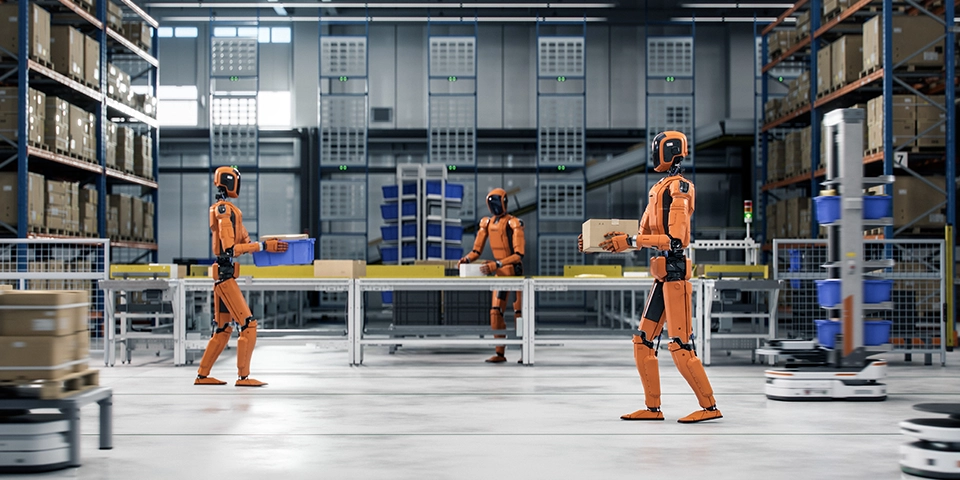
Now, imagine a humanoid robot walking down that same shop floor. It would not be fixed onto the ground. It would be walking, turning, lifting, and even deciding. This is the image that has captured the world’s imagination.
In 2025 alone, global shipments of humanoid robots touched nearly 18,000 units, a 508% year-over-year surge, generating close to $440 million in revenue, according to IDC. China led much of this growth, particularly in full-scale bipedal platforms. Clearly, the hype around humanoids in manufacturing is strong, with rapidly flowing investments, bold headlines on social media, and curious stakeholders. But as someone who works closely with manufacturers navigating automation decisions every day, the real story is more layered than the headlines suggest.
From Stunning Demonstrations to Sustainable Deployment
If you have watched a humanoid perform backflips or dynamically adjust to terrain shifts, the you have seen what modern AI-powered robotics, control systems, and actuation can achieve. While the engineering behind those demonstrations seems extraordinary, a factory floor is not a demo stage. Manufacturing operates on a different scoreboard:
- Uptime
- Throughput
- Safety compliance
- Integration stability
- Total cost of ownership
A humanoid that performs beautifully for five minutes on a test platform must perform flawlessly for 20 hours a day in a live production environment. That is a very different engineering challenge.
Forrester’s 2026 Trend Report on “The State Of Humanoid Robots, 2026” suggests that owing to the complexity in deployment, the high investment required for R&D, and uncertainty among regulatory authorities, will limit the scaling of the humanoids mainstream. As a result, only a small number of humanoids will generate sustained, revenue-producing work in the near term. Gartner projects that through 2028, fewer than 100 companies will move beyond proof-of-concept, and fewer than 20 will scale humanoids into live production across manufacturing or supply chains.
Those numbers may sound conservative, but they reflect operational reality. Bipedal locomotion introduces balance complexity. Dexterous manipulation demands advanced perception and control loops. Battery life constrains uptime. Safety validation becomes exponentially more intricate when machines share space dynamically with humans in human-robot collaboration.
In manufacturing, novelty is interesting. But reliability is everything.
Where Humanoids Robots Are Being Tested in Manufacuting
What is encouraging is that early adopters are not chasing spectacle – they are pursuing structure. Look at how leading OEMs are approaching deployment in smart manufacturing:
- At BMW’s Spartanburg facility, Figure AI's industrial humanoid robot completed its evaluation for intrafactory logistics within mapped, predictable zones.
- Mercedes-Benz did trial runs of US-based Apptronik's Apollo robot for structured tasks relevant to material handling robots, such as moving components and quality checks.
- Hyundai announced its plans to deploy Boston Dynamics Atlas at its Georgia Metaplant beginning in 2028.
- Agility Robotics continues expanding its bipedal humanoid, Digit’s deployments in warehouse environments.
Did you notice a pattern?
These trials and deployments are narrow, defined workflows for humanoid robots in factories. Mobility in controlled spaces with measured performance KPIs and low variability. No one is handing a humanoid the keys to a high-throughput, time-critical assembly line. And that is exactly the right approach.
Economics That Cannot Be Ignored
Let us talk about the part that often gets less attention when discussing advanced technologies: cost.
McKinsey revealed that humanoid prototypes range between USD 150,000 and USD 500,000 per unit, highlighting the current humanoid robot cost. For widespread adoption, that number likely needs to compress dramatically – perhaps into the USD 20,000-50,000 range – alongside major improvements in battery endurance (currently ~2 to 4 hours), maintenance cycles, system reliability, software maturity, and MES and plant integration.
Manufacturers do not evaluate automation philosophically. They evaluate it mathematically, such as cost per unit, throughput per hour, downtime impact, or labor substitution versus augmentation value. Right now, in many cases, specialized robotic arms, autonomous mobile robots (AMRs), and polyfunctional robotic platforms offer clearer short-term ROI. That does not diminish humanoids. It simply places them in the correct maturity stage.
Where the Long-Term Potential Truly Lies
Here is where we remain strategically optimistic. Humanoids may not dominate greenfield, hyper-optimized facilities anytime soon. But in brownfield plants where infrastructure redesign is expensive, they could eventually offer flexibility that fixed automation cannot. Consider legacy facilities with human-centric layouts, dynamic warehouses with shifting workflows, maintenance, inspection, and exception-handling tasks, and environments where variability is the norm, not the exception.
The broader general-purpose robotics market could reach USD 370 billion by 2040, according to McKinsey. If humanoids solve cost, energy, and reliability constraints, they could unlock meaningful value in precisely those spaces where rigid automation struggles. The question is not if humanoids will find a role. It is when their engineering maturity meets operational expectations.
What Manufacturing Leaders Should Do Now
This is not a wait-and-watch moment. Nor is it a rush and deploy moment. It is a design intelligently moment. Here is the ideal approach:
1. Run targeted humanoid robot pilots with defined KPIs - Tie experiments to measurable outcomes like cycle time reduction, labor gap mitigation, safety improvement, and energy efficiency. Curiosity is not a KPI.
2. Continue deploying ROI-positive automation today - There is immense value in specialized and polyfunctional platforms that are already delivering measurable results.
3. Plan integration early - System interoperability, digital twins, cybersecurity, and workforce enablement must evolve alongside hardware evaluation.
4. Take a portfolio mindset - Humanoids should be treated as one strategic option within a broader automation roadmap, not as a singular transformation lever in smart factory automation.
Road Ahead: Separating Signal from Spectacle
Humanoids have accelerated awareness in a way few technologies have. Viral videos create momentum. Venture capital amplifies narrative. But manufacturing transformation has never been built on spectacle. It is built on disciplined engineering, integration excellence, systems thinking, and measurable value creation.
As humanoid robots continue advancing quickly, we will need to remember that sustainable impact in manufacturing will belong to those who understand that progress is only about performance – relentless, reliable, and robust.
Explore how LTTS helps manufacturers evaluate, integrate, and scale intelligent automation across brownfield and greenfield operations.