

Published on 14 Aug 2026
min read
Views
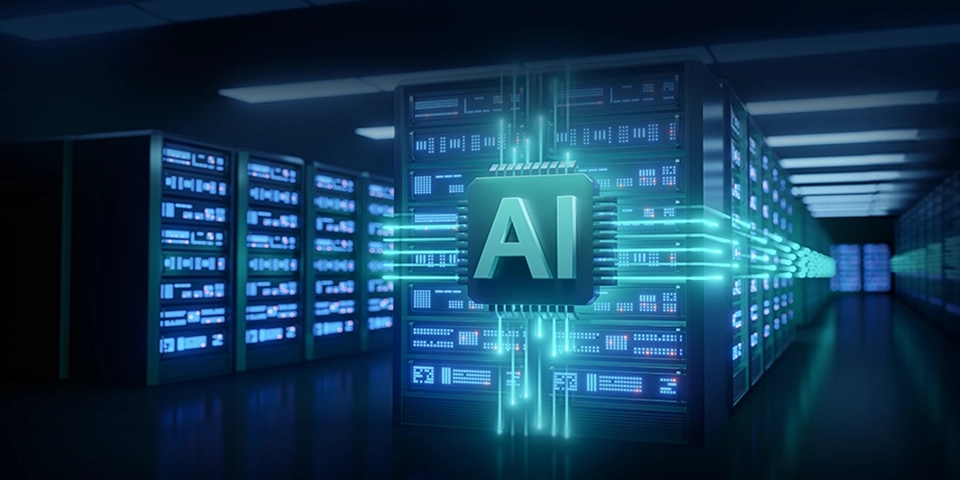
Every wave of AI has a physical bill, and it is often borne by the data center.
Rising AI training and inference workloads are pushing rack densities, power draw, and cooling loads to levels that would have looked reckless five years ago. However, the software layer meant to keep this under control has barely moved. Most data center infrastructure management solutions still just monitor parameters, and when something crosses a line, they ring an alarm and wait for a human to respond.
That model is quietly breaking.
When a facility generates tens of thousands of telemetry readings a minute across thermal, power, capacity, and mechanical systems, the infrastructure bottleneck is increasingly about judgment at speed. For instance, by the time a thermal alarm fires, the airflow problem that caused it has usually been built for an hour. The operator who catches it is not preventing the incident but is cleaning up after its early stages. Unlike before, the speed of decision and the need for action are in focus.
Agentic DCIM represents the next evolution of data center infrastructure management. It combines AI agents, real-time telemetry, and automated decision-making to continuously monitor, predict, and optimize data center operations across power, cooling, capacity, and maintenance systems. Unlike traditional monitoring platforms that primarily generate alerts, agentic DCIM enables intelligent action and continuous data center optimization.
From Reactive DCIM Monitoring to Self-Optimizing Data Centers
The more useful question here is not “how do we monitor better?” but rather, “what would it take for the infrastructure to manage itself?” That reframing turns Data Center Infrastructure Management (DCIM) from a reactive, alarm-driven function into a self-optimizing engineering system – one that continuously senses, predicts, decides, and acts – with humans governing the edges rather than manually driving the middle.
This is the thinking behind DataMind, an agentic DCIM platform designed around the premise that a data center should behave less like a set of gauges and more like an engineering team that never sleeps. Instead of a single monolithic model, it runs a mesh of specialist agents, each owning a domain the way a good operations team divides responsibility.
The thermal agent reads CRAC, CRAH, and rack sensors to predict hotspots roughly 45 minutes before they would trip an alarm, then adjusts setpoints, while the power agent tracks PUE in real time, rebalances loads across PDUs, and watches UPS health. In tandem, the capacity agent projects exhaustion months ahead and recommends workload migration before you run out of room, and the predictive-maintenance agent estimates failure probability per device and raises a work order while there is still time to act. And finally, the sustainability agent ties it all back to carbon emissions, matching renewable energy and shifting non-critical load to lower-impact windows.
The decision loop here matters more than any single feature, with signal to corrective action being delivered in under half a second – running continuously rather than on a human technician's schedule.
The Lock-In Problem: Why Vendor-Locked DCIM Limits Data Center Optimization
Traditional DCIM tools tend to live inside a single vendor's ecosystem. Your intelligence is only as good as the hardware brand that sold you the platform, and stepping outside it means expensive licenses, integration projects, or both.
Real data centers, however, are never that tidy.
They are a patchwork of PDUs, UPS units, CRACs, and servers from a dozen manufacturers accumulated over years of procurement. The pragmatic answer to effect DCIM, therefore, is to talk to the hardware directly. By polling equipment through open industrial protocols – Modbus, SNMP, BACnet/IP, Redfish, MQTT and others – an intelligence layer that can read almost any brand without waiting for a vendor's API or paying for a vendor's DCIM tier is what makes genuine, fleet-wide optimization possible in the first place.
Governed Autonomy for Trusted Data Center Operations
The instinct to keep a human “in the loop” is correct, but it is usually implemented as a bottleneck. As a result, every decision waits for approval, and scaling is stalled.
A more pragmatic pattern then is governed autonomy. Low-risk, high-confidence actions execute on their own – with a short cancellation window and a clear audit trail – while high-blast-radius decisions are gated behind human review and a confidence threshold. Operators move along a spectrum, from reviewing everything, to supervising with the option to cancel, to letting the system handle the 80% routine while surfacing only the genuinely complex or physical calls.
The quiet innovation enabled by DataMind then lies in the feedback loop. When an operator overrides the system with their own action, that override is not discarded – it becomes a training signal. The model learns what data center engineers consider the right response, and so, trust is earned through evidence rather than asserted in a datasheet.
Results that Matter
The goal for an efficient DCIM is never about just a smarter alarm, but rather, infrastructure that continuously thinks, decides, and acts. It is vendor-agnostic in what it reads, disciplined in what it does autonomously, and honest about where a human still belongs. And as AI reshapes what we ask of data centers, the facilities that keep up are the ones that stop waiting to be told there is a problem and start engineering it away before it fires.

 LLMs May (Yet) Fall Short of Saving the World">
 LLMs">