Published on 03 Aug 2026
min read
Views
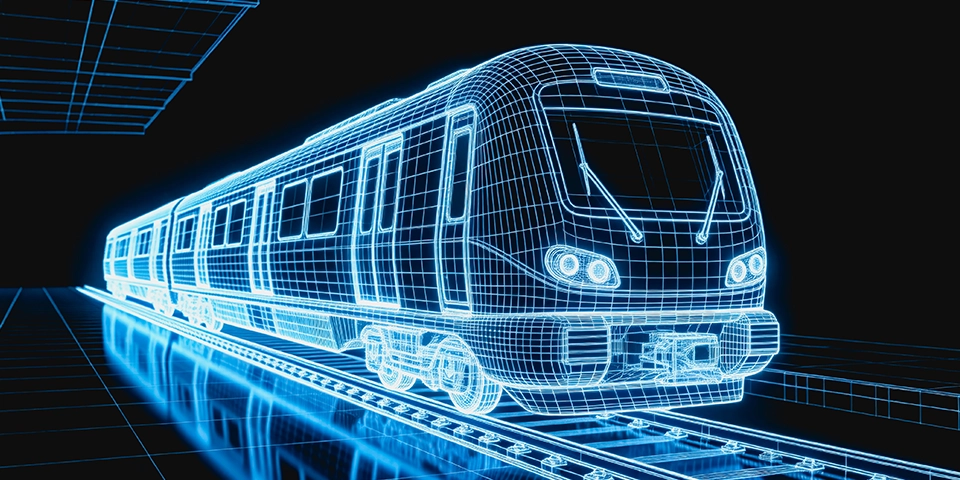
For over a century, railways competed by expanding physical capacity – more track, larger rolling stock, and increasingly sophisticated signaling. Today, however, capacity alone no longer defines competitive advantage.
Amidst an expanding global railway infrastructure market expected to cross USD 362 Billion by as early as 2035, the operators pulling ahead are the ones who have engineered their infrastructure, operations, and data to work as a single system.
This shift has a name: connected railways. And it is redefining what a competitive rail network looks like.
Why the old operating model is running out of road
The pressures on rail transport operators are manifold. Infrastructure is aging. Traffic volumes keep climbing. Safety expectations rise every year, and sustainability mandates now sit on the same agenda as on-time performance.
Against these real-life pressures, the traditional playbook – periodic inspections, siloed systems, decisions made after something has already gone wrong – simply cannot scale.
The problem here is not a lack of data, since railways generate enormous amounts of it – across tracks, signaling systems, rolling stock, stations, depots, and day-to-day operations. Rather, the challenge centers on the fact that this data sits in disconnected systems that do not talk to each other.
An operator can be data-rich and insight-poor at the same time, which is a frustrating place to run a network from.
This is exactly the gap that connected rail infrastructure is built to close.
What "connected" really means
A connected railway is one where the infrastructure continuously senses, communicates, analyzes, and responds – in real time, not on a quarterly inspection cycle. Instead of leaving data stranded in individual systems, a connected ecosystem links physical assets to operational intelligence on a shared digital foundation.
This enhanced window of insights into infrastructure health, network performance, and operational risk lets teams move away from reacting to failures and toward anticipating them. And once they can see the whole network as it actually is – minute by minute – a significant number of downstream decisions get easier. From where to send a maintenance crew, which asset to prioritize, how to keep service running when conditions turn against you – choices are aplenty.
The business case follows directly from that visibility – better reliability, higher asset utilization, lower maintenance costs, and a smoother experience for both passengers and freight customers. Which is why, in a growing number of organizations, connectivity has stopped being an IT project and become a boardroom priority.
The digital nervous system underneath it all
If connectivity is the strategy, IoT in railways is the mechanism that makes it real.
The practical work of building smart railway infrastructure comes down to instrumenting the network so it can report on its own condition. Sensors, edge devices, communication networks, and cloud platforms combine together to link tracks, signaling equipment, electrical systems, rolling stock, stations, and wayside assets into what is best described as a digital nervous system.
Each part of the network can sense what is happening to it and pass that signal on.
The value here does not lie in the raw readings, but in the context. A connected ecosystem captures operational data in near real time and stitches it into a coherent picture of how the network is performing and how its assets are holding up. Instead of waiting for the next scheduled inspection to discover a developing problem, operators get continuous awareness of changing conditions and can act on the ones that matter before they threaten safety, reliability, or service availability.
The goal moves from detecting failures to preventing them. And the challenge for this is especially evident when we consider the fact that unlike greenfield digital infrastructure, most railway networks must modernize while remaining operational. This involves integrating decades-old assets with new digital technologies without compromising safety or availability.
From connectivity to business value
It is worth being honest about the sequence here, because connectivity on its own does not transform anything.
Instrumenting a network gives you visibility. But visibility is the raw ingredient, not the finished product. The operators who get the most from digital railway solutions are the ones who treat connectivity as the foundation for something larger – predictive maintenance, intelligent asset management, better traffic flow, stronger resilience, and eventually decision-making that is led by data rather than by experience alone.
That is the arc this series follows. This first part is about the foundation: what a connected railway is, why the traditional model is reaching its limits, and how IoT-enabled infrastructure can help create real-time visibility everything else depends on.
From there, the picture only gets more interesting.
The next stage is where that visibility starts paying off – turning continuous monitoring into genuine foresight through rail asset monitoring, condition-based maintenance, and AI.