Published on 30 Sep 2026
min read
Views
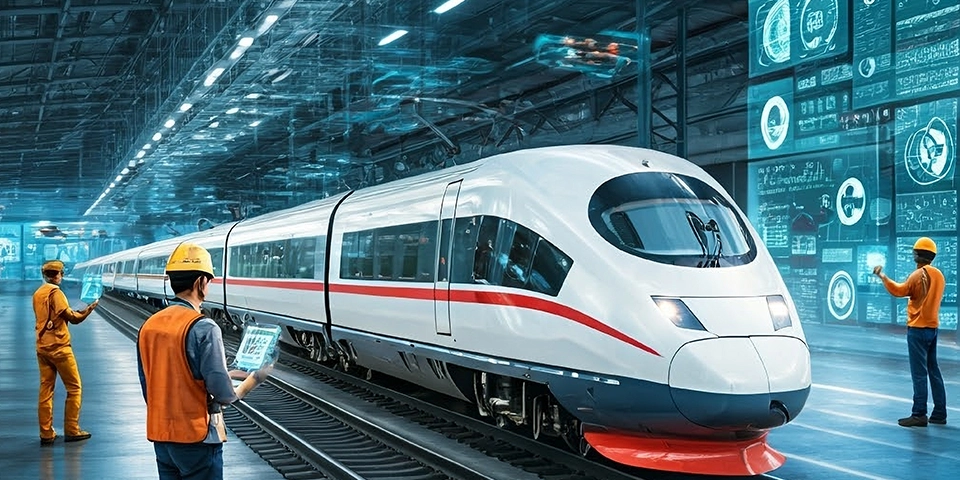
Rail networks worldwide are being asked to move more passengers and more freight – at higher speeds and higher frequencies – with less tolerance for disruption than ever before. At the same time, much of the underlying infrastructure is ageing and the specialist workforce that has traditionally walked the track and inspected the fleet is shrinking.
This comes up frequently in my conversations with railroad leaders: “You cannot run a twenty-first-century railway on a twentieth-century maintenance philosophy.” And the industry knows it.
This is why AI predictive maintenance in railways is moving from being a promising pilot topic to a board-level priority. The question is no longer whether to adopt it, but how quickly operators can move up the maturity curve – from repairing assets after they fail, to predicting failures before they happen, and ultimately to systems that recommend the right intervention on their own.
AI Predictive Maintenance in Railways
Predictive maintenance in railways is the discipline of using sensor data and machine learning to forecast when a specific asset is likely to fail, so it can be serviced at precisely the right moment. It is best understood as one point on a maturity curve that every operator is travelling along:
- Reactive: fix it when it breaks.
- Preventive: maintain it at fixed intervals so it doesn’t break.
- Predictive: use data to predict when it will break, and fix it accordingly.
- Prescriptive: go a step further – let the system recommend how to avoid the predicted failure altogether.
A working predictive-maintenance capability rests on three layers. The first is data acquisition: a dense mesh of trackside and onboard sensors, high-resolution and thermal cameras, laser profilers, LiDAR, acoustic and vibration sensors, drones, and data drawn directly from OEM systems. The second is analytics that live both at the edge and in the cloud – edge processing so that a critical anomaly can trigger an alert in real time, near the asset, without waiting on connectivity; and cloud analytics to correlate patterns across the whole fleet and network over time. The third is the AI itself: models that detect and classify defects, distinguish normal wear from genuine risk, and forecast remaining useful life.
At LTTS we find it useful to think about these models in three complementary families.
Physical AI grounds predictions in the deterministic engineering physics of rail systems, so a forecast is consistent with how the asset actually behaves. Generative AI helps engineers and operators interrogate that intelligence in natural language, drawing on manuals, datasheets and historical records. And agentic AI is beginning to automate the workflows around a prediction – raising the work order, scheduling the intervention, and closing the loop. Used together in tandem with a real engineering outcome rather than novelty, this is what makes prediction trustworthy enough to act on.
AI Predictive Maintenance for Rolling Stock
Rolling stock is where predictive maintenance often delivers its most visible safety and cost benefits, because a fault on a moving vehicle carries immediate consequences. Wheels, bearings, brakes, bogies, doors and propulsion systems all degrade in ways that leave a measurable trail.
Wheel profile measurement systems now scan the wheels of a train in motion, contact-free, to within a few hundred microns – flagging tread wear and flange defects that drive both derailment risk and track damage. Hot box detectors identify hot-running bearings and dragging brakes early, catching precisely the conditions that can otherwise lead to axle fractures or fires. Machine-vision inspection systems read wagon and locomotive numbers automatically and detect mechanical defects in real time as a rake enters a yard, replacing slow and subjective manual checks.
And condition-based monitoring of brake pads, propulsion and engine health lets teams intervene on evidence rather than on assumption – in one deployment, reducing brake-pad replacement times by around 15 percent while improving safety. The common thread is simple: the vehicle tells you what it needs, and you act before a defect becomes a failure.
AI-Based Track and Infrastructure Monitoring
Track and lineside infrastructure present the opposite challenge to rolling stock – not a single moving asset, but thousands of kilometers of fixed infrastructure that must be inspected continuously. This is where computer vision and edge analytics have transformed what is possible.
Our indigenous, patented track inspection platform, TrackEi™, is a good illustration. Multi-angle high-resolution cameras and 2D laser profilers, combined with GPS-RTK positioning accurate to roughly a meter, detect and classify a wide range of defects – surface wear and corrugation, hairline cracks, gauge variation, geometry deviation, broken rails and joint failures – in real time, with predictive analytics that forecast where the next failure is likely to develop. In practice this kind of capability has cut inspection times by around half and achieved defect-detection accuracy of roughly 90 percent, while turning inspection from a periodic event into a continuous, data-rich picture of network health.
For the highest-consequence failure of all – a broken rail – several complementary technologies now work in areas with little or no signaling coverage. Track-circuit-based broken-rail detection delivers extremely low false-positive rates and localizes a break to a specific track section. Acoustic-emission sensing listens for the high-frequency signatures of micro-fractures and can raise an alert before a full rail break occurs, pinpointing the event to within tens of metres. Increasingly, the same AI processing pipeline can ingest drone-captured imagery, extending autonomous inspection to structures and corridors that are difficult or unsafe to reach on foot.
The Business Case: Safety, Reliability and Asset Availability
For all the sophistication of the technology, the case for AI predictive maintenance rests on a handful of outcomes that every railway leader recognizes:
Safety first, including detecting broken rails, overheating bearings and structural distress before they escalate directly reduces the risk of derailments and lineside incidents. Prediction moves safety from a reactive posture to a preventive one.
Reliability and availability, by intervening only when an asset genuinely needs it – and always before failure – operators cut unplanned downtime sharply; predictive-maintenance platforms have reduced asset downtime by as much as 40 percent in service. Fewer surprise failures mean fewer delays and a more dependable timetable.
Cost and productivity, when condition-based intervention ends the waste from over-maintaining healthy assets and the far greater cost of catastrophic ones. Automated, AI-assisted inspection roughly halves inspection effort and frees scarce skilled engineers to focus on judgement rather than data collection.
Sustainability and workforce, includes extending asset life, optimizing energy use and reducing wasted maintenance all support sustainability goals – while AI augments an ageing, shrinking specialist workforce rather than trying to replace it, capturing hard-won expertise in the system itself.
What Comes After the Prediction
The most interesting frontier is no longer prediction itself, but what happens once a failure has been predicted. Prescriptive maintenance closes the gap between insight and action – the system does not just warn that a bearing will fail, it recommends the optimal response, and, with agentic AI, can increasingly orchestrate the workflow that follows.
This is where autonomous rail engineering and operational workflows begin to take shape: intelligence that plans, schedules and coordinates the human and machine effort required to keep a network running.
My own conviction, having worked across mobility for many years, is that this technology only earns its place when it is purposeful – built for engineering outcomes, not for optics. AI-enabled predictive maintenance is one of the clearest examples of that principle in action – and it is ready for operators to act on today.