Published on 23 Oct 2026
min read
Views
For most of rail's history, knowing the state of a line involved humans walking along it for manual inspection. Inspectors covered their stretch of track on foot, reading the rails and ballast by eye, and many still do.
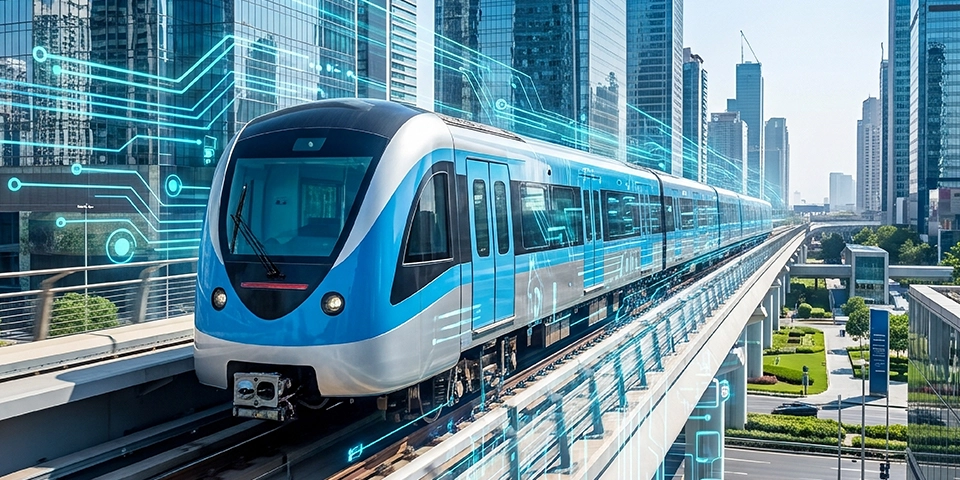
Increasingly, though, the best picture of a railway's health comes from the adoption of technology: cameras under passing trains, sensors on point motors, signaling systems that know where every train is.
That shift is arriving as rail spending keeps growing. UNIFE's latest World Rail Market Study, launched at InnoTrans in September, expects the global rail supply market to grow by 3.2% a year on average. That would take it from around €221 billion in 2023–25 to €266.8 billion in 2029–31.
However, the hours available to work on the track are not growing with it. On a busy network, every extra train on track further narrows the window for maintenance.
Digital railway transformation is, therefore, an operational question. Can an operator turn what its assets report into the right work, in the right window, with evidence that will stand up to scrutiny? Helping operators do that is fast becoming the core job of railway engineering services.
Rail already has the data
By early 2019, Network Rail's monitoring trains were photographing the track every 0.8 mm, about 70,000 images a second at 125 mph. They had already replaced manual inspections on 8,500 miles of track. And by as recent as mid-2020, Deutsche Bahn had connected 28,000 points to sensors that measure the power each point motor draws and flag anything unusual. The technology has helped DB prevent 3,600 defects.
Smart signaling adds another stream. Electronic interlockings can log every route set and point movement, and communications-based train control (CBTC) tracks each train's position continuously rather than block by block. Add IoT in railways more broadly, on bearings, pantographs, doors and escalators, and the volume becomes the problem.
A camera taking 70,000 images a second does not decide. Someone – a human or an intelligent system – works out which of those images shows a defect worth tonight's maintenance window, and which can wait. The bottleneck has moved from sensing to deciding.
What this asks of railway engineering services
Operators and OEMs have traditionally bought engineering in pieces: design this bogie, test that interlocking, support this fleet. The digital railway needs something harder, which is engineering the whole chain from sensor to work order. Four capabilities matter most.
Start with the edge. A camera-equipped train can produce more imagery than a mobile link can practically carry, so detection increasingly runs on board, on hardware that survives vibration and dust.
Then comes integration across eras. Rail assets last for decades, so one route can mix relay interlockings, solid-state systems and new sensors from several suppliers. Rail data analytics only works once every reading can be tied to a specific asset at a specific moment.
Assurance is the third. Railway software is developed under safety standards such as EN 50716, and anything that influences a safety decision needs evidence an assessor will accept. AI earns its place by spotting problems early and ranking them. Qualified people and certified systems keep the final say.
Finally, security has to be designed in, because every connected sensor is also an entry point. Rail industry associations UNIFE, CER and UITP describe Europe's Cyber Resilience Act as covering products "from smartphones to locomotives". Since September 2026, manufacturers have had to report actively exploited vulnerabilities, and the main obligations apply from December 2027.
None of these capabilities is new on its own. Engineering them as one system is, and it is what separates a pilot from a program.
Where LTTS is focusing
Our rail work concentrates where data and safety meet: smart signaling, track inspection and condition monitoring.
In smart signaling, our engineers work across route relay interlocking, solid-state interlocking and CBTC, alongside train controls and system engineering. That range matters, because most networks will run old and new signaling side by side for years.
In track inspection, our AI-based TrackEi™ system runs deep learning on the NVIDIA Jetson™ edge AI platform. High-resolution cameras and laser profiling let it flag broken rails, cracks and misalignments as the train moves, with processing on board to cut latency and bandwidth. In one client engagement, TrackEi™ ran at more than 100 km/h and helped double inspection efficiency while cutting inspection effort by 40%.
In condition monitoring, we build IoT-enabled diagnostics and predictive maintenance that help turn asset signals into maintenance priorities. Predictive maintenance in railways pays off only when its alerts arrive in a form a planner can act on.
For us, that is what Engineering Intelligence means in rail: AI that works on the train and at the asset, where the problem sits, rather than on a dashboard after the fact.
Engineering the intelligence layer of rail
The next phase of digital rail transformation will not be decided by who installs the most sensors. It will be decided by who can answer three questions for every new data stream. Which decision does it change? Who is accountable for acting on it? Can we prove it is safe and secure?
Smart signaling, track inspection, condition monitoring and AI are the building blocks of digital railway solutions. Engineering them into one system people can trust is the real work, and it is what operators should expect from their rail engineering services partners.
Inspectors will still walk the line for years to come. The difference is that they will know where to look.