Published on 02 Sep 2026
min read
Views
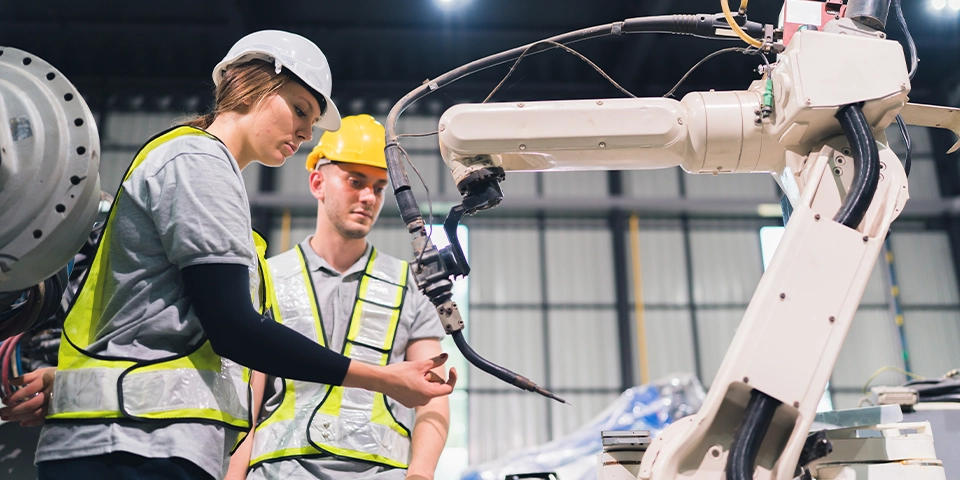
Robots have been a core feature of digitally-mature shopfloors for over 4 decades now. However, today’s industrial robots look nothing like the six-axis articulated arms of the 1980s. Modern intelligent robots can see, hear, and sense touch and force variables as they operate on the shopfloor. While this has endowed robots with greater execution autonomy, it has also unlocked an unprecedented opportunity for manufacturers.
As modern robots accumulate more sophisticated sensing and computational capabilities, manufacturers can now apply them to build a truly smart manufacturing environment and an intelligent shopfloor. With the capability to sense and act, robots will now become a manipulable interface that sits between the digital and physical domains, enabling unmatched velocity, responsiveness, and efficiency levels in intelligent manufacturing operations.
Adaptive, Perceptive, Connected: The New Capability Stack of Industrial Robots
The core USP of legacy industrial robots was deterministic execution. These robots were governed by proprietary motion controllers and coordinated through hardwired PLC logic, discrete I/O, and fieldbus networks. Their control loops were closed only around servo position and velocity; perception was minimal, typically limited to encoders, limit switches, and fixed fixturing that engineered variability out of the process. That is why robots sat squarely in the execution layer underneath planning systems and upstream of material flow.
With modern robots, everything has changed. Today’s industrial robots:
- Are simultaneously data consumers, producers, and processors within a distributed manufacturing technology ecosystem.
- Their controllers now host multi-core CPUs and, increasingly, embedded AI accelerators capable of running vision inference, force estimation, and motion-planning algorithms at the edge.
- Have integrated 2D/3D vision, wrist-mounted force/torque sensors, safety-rated lidar, and tactile grippers, which allow robots to localize parts, detect humans, and adapt grasp strategies.
- Can ingest contextual data from MES and quality systems and stream crucial telemetry data such as torque curves, cycle deviations, and inspection results.
As a result, modern industrial robots are no longer an execution endpoint. They act as perceptive and adaptive software-defined robotics nodes in a networked intelligence layer. In other words, today’s robots are capable of participating directly in sensing, decision-making, and continuous process optimization across the factory – capability being the keyword here.
Modern Industrial Robots: Ground Zero of Intelligent Manufacturing
In order to exploit sophisticated motion, control, sensing, and computation capabilities of modern robots, their position in the manufacturing technology stack must be reconsidered. Their expanded capability set does not merely enhance performance at the task level; it restructures how feedback loops are designed, how quality is assured, and how maintenance is scheduled.
Below, observe the specific mechanisms through which modern robots reimagine processes and core elements of the manufacturing operating model.
#1. Multi-modal sensing for live feedback and control
Today, industrial robots ship with advanced computer vision, auditory, tactile sensing in robotics, and force sensing abilities. This means that variability in processes need not be eliminated mechanically, as was the case in legacy robot deployments. Now, robot vision systems and force sensors shift that burden from hardware to computation.
For instance, embedded 2D and 3D vision modules running within the controller allow robots to localize parts, compute dynamic work object frames, and update tool center point (TCP) offsets in real time. Similarly, wrist-mounted six-axis force and torque sensors enable impedance and admittance control strategies, allowing compliant interaction during insertion, fastening, polishing, or deburring.
These capabilities have significantly altered process design strategies. Parts need not be deterministically oriented for bin-picking, and press-fit assembly can adapt to micron-level variation without manual tuning. In conventional automated systems, execution is a fixed replay of a programmed motion, whereas now, intelligent robots use feedback-driven control to continuously evaluate and correct robotic execution in the process.
#2. Real-time inference through on-controller AI capabilities
The defining shift in intelligent robotics lies in the injection of decisioning capability into the controller itself. Legacy robots executed pre-validated motion paths and relied on supervisory systems or operators when exceptions occurred. Today, multi-core processors and embedded AI accelerators inside robot controllers enable inference to occur within the same control cycle as motion execution, advancing AI in manufacturing.
The impact of native intelligence extends beyond the radius of task execution. For instance, vision-based defect classification models can immediately reject parts without sending the data to an external quality evaluation system. If a casting shows porosity, a weld bead exhibits discontinuity, or a component is missing, the robot can immediately reroute the part to a reject bin or secondary inspection path, without waiting for the decision from the MES, or worse, propagating the defect downstream.
Similarly, torque and current signatures captured during fastening or press operations can be compared in real time against learned profiles. Deviations in slope, peak torque, or angle-to-yield curves can indicate cross-threading, stripped threads, or incomplete seating. In such cases, the robot can pause, retry, or flag the operation before downstream assembly continues.
These capabilities ultimately converge execution, validation, and correction into milliseconds-long a feedback loop embedded at the edge.
#3. Granular process intelligence from robot telemetry
Unlike legacy robots that generated basic data such as cycle count or uptime, modern robots generate high-frequency, high-signal telemetry data. Joint torque values, motor currents, positional deviation, vibration signatures, and energy consumption are captured continuously at millisecond resolution. Modern robots are now capable of exposing this data through standardized interfaces, making it available to analytics pipelines in real time for smart manufacturing environments.
This data can be exploited by upstream systems to gain valuable insights into process-level blind spots. For instance, torque curve profiles during threaded fastening can be analyzed to verify clamp load integrity and detect thread damage. Similarly, a gradual drift in RMS servo motor current may indicate gearbox wear or lubrication breakdown, which can be fixed before mechanical failure occurs.
These insights not only make it possible to diagnose issues with the robot but also to observe the process itself with a level of granularity that was previously not feasible. This shifts maintenance, quality assurance, and end-of-line inspection tasks, enabling detection of exceptional and edge cases at the point of origin. Ultimately, this makes the operating model more adaptive and intuitive, while driving a meaningful reduction in opex, wastage, and cost of manufacturing.
Next Steps: Integrating Modern Robots for Intelligent Operations
The evolution of manufacturing from automation to intelligence is determined by how modern robots are integrated into the manufacturing architecture through effective robotics systems integration. Multi-modal sensing, on-controller inference, and granular telemetry create potential for intelligence, whereas integration will determine whether that potential is realized.
Intelligent robots must therefore be integrated at three levels:
- First, control-layer integration: where perception and inference are embedded within servo cycles.
- Second, data-layer integration: where standardized interfaces stream high-resolution telemetry into analytics systems for quality and condition monitoring.
- Third, process-layer integration: where robotic feedback loops influence scheduling, routing, and inspection logic in real time.
When these three layers are coherently integrated, manufacturers will be able to attain self-correcting and condition-aware production systems with built-in-process quality assurance. This will enable increased production velocity, the ability to handle high-variability SKUs in high-mix low-volume manufacturing, and a lower cost of manufacturing complex parts – outcomes that manufacturers have long desired, but were incapable of realizing with automation-first robots.
Explore how LTTS helps manufacturers integrate intelligent robotics, edge AI, industrial data, and connected controls to build adaptive factory operations.