Published on 04 Jun 2026
min read
Views
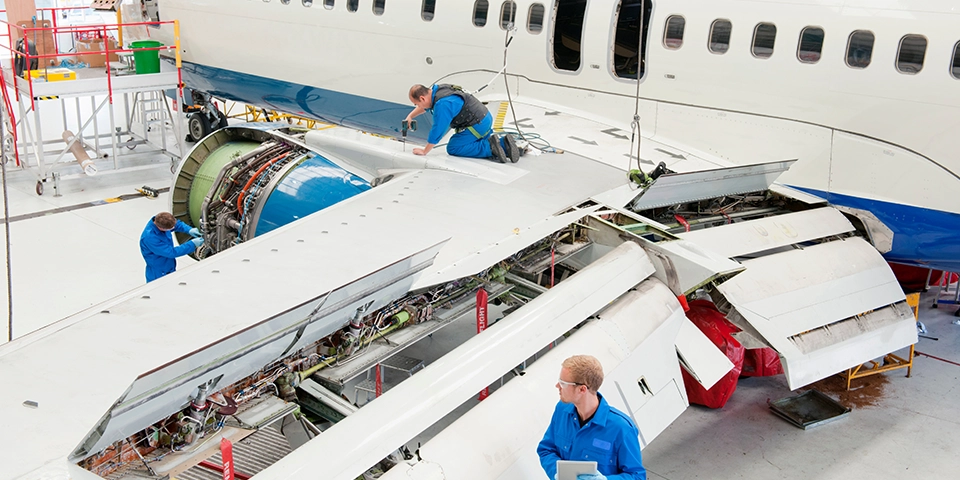
In aerospace manufacturing, there is very little margin for error. A delayed component, an undetected defect, or an unexpected equipment failure can trigger cascading consequences across production schedules, regulatory compliance, customer commitments, and operating costs.
For decades, the industry managed this complexity through precision engineering, tightly controlled production environments, and highly standardized manufacturing processes. Stability mattered more than flexibility. Predictability was the operating model.
That model is now under pressure.
Aircraft demand is rising again as fleets are being modernized and the demand for electrification, advanced materials, connected systems, and software-defined architectures increase product complexity across the landscape. At the same time, aerospace manufacturers are dealing with supply chain volatility, workforce shortages, inflationary pressure, and growing sustainability expectations.
The challenge is no longer simply building better aircraft, but scaling production while simultaneously improving quality, accelerating delivery timelines, managing costs, ensuring compliance, and building resilience into operations. This is where the idea of the smart factory is becoming strategically important, especially as the foundation for a more intelligent manufacturing model.
Why Traditional Manufacturing Models Are Reaching Their Limits
Historically, aerospace manufacturing systems were designed for longer production cycles and relatively stable operating conditions. Processes were optimized around repeatability and control.
Modern aircraft programs, however, involve increasingly interconnected systems spanning electronics, embedded software, advanced composites, connectivity platforms, and digital controls. Engineering and manufacturing can no longer operate in silos, with a change in one part of the system creating downstream impacts across production, suppliers, certification, and maintenance operations.
At the same time, the aerospace supply chain has become far more fragmented. Many Tier 2 and Tier 3 suppliers are still early in their digital transformation journeys, creating visibility gaps and operational inconsistencies across the ecosystem.
The result – a manufacturing environment that is significantly more dynamic and harder to manage with conventional operating models.
The Real Shift is from Reactive Manufacturing to Intelligent Manufacturing
Traditional manufacturing environments are largely reactive, where problems are identified after they occur. Equipment is repaired after failures happen and Bottlenecks become visible only once schedules begin slipping.
A smart factory changes that equation. By connecting engineering, manufacturing, operational, and supply chain data in real time, manufacturers gain the ability to anticipate disruptions before they escalate. Production systems become more adaptive, maintenance is predictive, and quality issues can be identified earlier in the process rather than downstream after costly rework. In effect, manufacturing paradigms starts evolving from a production function into an intelligence layer.
That distinction matters because aerospace competitiveness is increasingly being shaped not only by engineering excellence, but by the ability to make faster, more informed operational decisions at scale.
The Business Value Extends Far Beyond Efficiency
Productivity gains and cost reduction are often the most visible benefits associated with smart factories. Those outcomes matter, particularly in an industry under constant pressure to improve margins and delivery performance.
But the long-term value is much broader.
Smart factories improve production visibility, strengthen traceability across the product lifecycle, and create greater responsiveness to regulatory requirements and customer demand fluctuations. They also help manufacturers ramp production more confidently in periods of market expansion.
Perhaps more importantly, they create continuity between manufacturing and downstream lifecycle operations. As aerospace companies place greater emphasis on lifecycle value creation, manufacturing data itself becomes a strategic asset. Insights generated during production can support maintenance, repair, and overhaul (MRO) operations long after an aircraft leaves the factory floor.
This is one of the most important shifts underway in the industry, where the factory is no longer just a place where products are built, but rather, is a continuous source of operational intelligence across the lifecycle of the asset.
The Industry is Moving Toward Connected, Adaptive Production
Several trends are accelerating this transition. Digital twins are enabling aerospace manufacturers to simulate production environments and validate engineering changes before physical implementation. AI is increasingly being used to support predictive maintenance, anomaly detection, quality inspection, and supply chain analysis.
Sustainability is also becoming deeply connected to manufacturing strategy. Energy optimization, waste reduction, and more efficient resource utilization are now operational priorities as much as environmental ones.
At the same time, recurring global supply chain disruptions have reinforced the importance of visibility across supplier networks and production ecosystems.
Taken together, these trends are pushing aerospace manufacturing toward a model that is more connected, adaptive, and intelligence-driven than traditional factories were ever designed to support.
Execution at Scale Remains the Hardest Part
Most aerospace companies already recognize the strategic importance of intelligent manufacturing. The real challenge is execution.
Scaling transformation across large manufacturing environments is difficult, particularly in organizations operating with legacy infrastructure, fragmented data systems, and deeply established operational processes. Cybersecurity concerns, workforce readiness, integration complexity, and uncertainty around ROI often slow adoption further.
Yet despite these challenges, the flight path is increasingly clear. The aerospace smart factory is evolving into the operational control center of the modern aerospace enterprise, capable of improving resilience, traceability, flexibility, and decision-making across increasingly complex manufacturing ecosystems. The larger question for aerospace leaders therefore is whether organizations can adapt quickly enough to the opportunities that await.