Published on 24 Nov 2026
min read
Views
Why Aerospace AI Decisions Begin Long Before an Aircraft Is Grounded
It is 3 a.m. at a hub airport. A widebody that should be pushing back in four hours is instead dark at the gate, a single fault message glowing on a maintenance laptop.
The clock has started, and in commercial aviation that clock is merciless. A grounded aircraft can burn anywhere between USD 10,000 to 150,000 an hour before the first spare part even arrives.
This is the uncomfortable truth that should shape how every aerospace segment head thinks about artificial intelligence: the fix for this scenario was probably determined years earlier, at a design review nobody remembers.
How AI in Aerogineering Is Evolving from Point Solutions to a Connected Lifecyclspace Ene
For a decade, "AI in aerospace engineering" described a scatter of clever point solutions – a generative-design plug-in here, an anomaly detector there, a chatbot bolted onto a maintenance manual. Useful, but disconnected.
The shift now underway is more fundamental. AI in aerospace is becoming a continuous thread that runs the length of a program, from the first topology study to the last line-replaceable unit swapped out in service, rather than a set of favors performed at isolated workstations.
That distinction is the whole story. The global AI in aerospace and defense market is projected to grow from around USD 33 billion in 2026 to USD 55 billion by 2030. And most of that spend will be wasted if it merely buys faster silos.
The focus, increasingly, is on connective tissue.
How AI-Driven Design Optimization Accelerates Aerospace Engineering
Start at the front end, where the leverage is greatest.
Every bit of incremental weight designed into an airframe is paid for in fuel for thirty years. Generative AI and AI-driven simulation addresses this directly – defining the loads, materials and constraints – exploring thousands of geometries a human team could never draw by hand. NASA's Goddard team has reported that pairing generative design with digital manufacturing can cut spacecraft structure development time and cost by as much as tenfold.
But a lighter bracket is not the prize. The focus is on compressing the design-analyze-iterate loop so that engineers can spend their judgment on the hard trade-offs instead of the redraw. Aerospace digital engineering matures not when one part gets lighter, but when the next thousand parts inherit that intelligence – automatically.
Why Explainability and Traceability Are Critical for Certifying AI in Aerospace
Here is the contrarian point I would put on the table in any leadership discussion.
The constraint on AI in aerospace is not model capability, but rather, trust. An aircraft flies under DO-178C, DO-254 and ARP4754A because every requirement traces to a test and every failure mode is understood. A generative model that produces a brilliant geometry cannot explain if it is, from a certification standpoint, a liability rather than an asset.
That makes the investment case grounded into the realities of the extreme focus on safety, and reliability in the Aerospace wor
The frontier worth funding is not autonomy for its own sake but explainability, traceability, and a disciplined human-in-the-loop. Model-based systems engineering and a governed digital thread are not the boring back office of an AI strategy – they are the strategy. SME-validated models and airtight data lineage as first-class deliverables are therefore the deciders on which AI makes it onto a certified aircraft. The rest are just demos.
How Predictive Maintenance and Digital Twins Reduce Aircraft AOG Risk
Now jump to the other end of the lifecycle, and back to that dark gate. Unscheduled maintenance is where AI's business case is least debatable. US operators average roughly fourteen aircraft-on-ground events per aircraft each year, and industry estimates put the total cost of flight disruptions near $60 billion annually — close to eight percent of revenue.
Aerospace predictive maintenance, aircraft health monitoring and the digital twin turn that reactive scramble into a forecast. Multi-sensor models predict remaining useful life, correlate fault logs against maintenance history, and surface the precursor pattern weeks before the failure declares itself. In real engagements these approaches have delivered 20 to 30 percent reductions in unplanned downtime and 25 to 35 percent improvements in failure predictability.
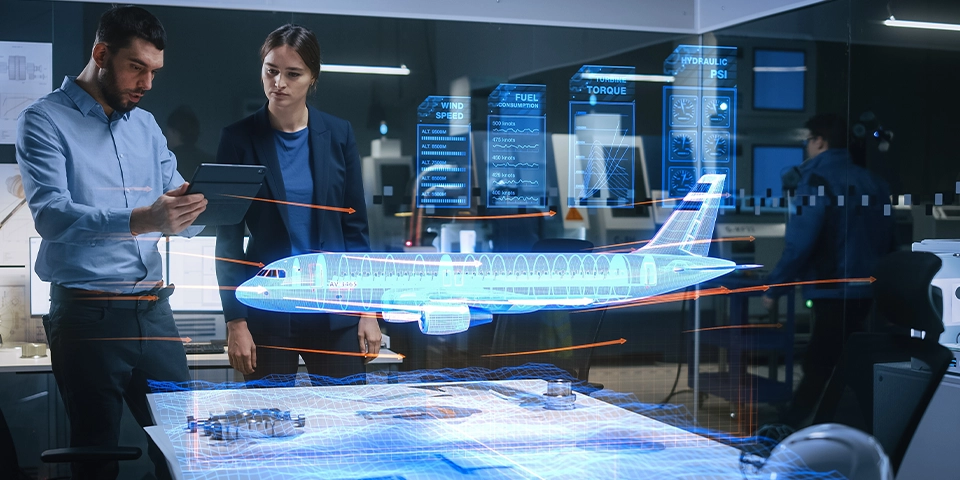
A digital twin in aerospace, therefore, makes it concrete – a living model of a specific tail number, fed by its own telemetry, answering the only question that matters at 3 a.m.: what breaks next, and when.
Closing the loop: from data to engineering intelligence
Generative design and predictive maintenance are already commoditizing, and every serious OEM will have both within a few years. The durable advantage is what connects them.
Picture the crack signature detected on a wing spar in year twelve of service automatically informing the topology of the next airframe's bracket – the field teaching the design desk, continuously, without a human ever manually filing the lesson. That closed loop is what engineering intelligence represents – a data spine where manufacturing, operations and maintenance feed back into design, and the aircraft program becomes a system that learns from itself.
Building that loop is far more an organizational achievement than a technical one. It demands a governed data foundation, a culture that trusts models enough to act on them and questions them enough to stay safe, and the patience to invest in plumbing that does not demo well.
While unglamorous, it is also the whole game, and the line between adopting AI tools and building a genuinely AI-led aerospace enterprise.