Home

Search


Header (Main)
Engineering Intelligence
Industry
Engineering Intelligence

Intelligence in everything we build; and everything we build with.

Design and certification. The product in the field. The factory behind it. One governed agentic platform beneath all three.

Know More
Mobility
Automotive
Aerospace
Railway
Commercial & Recreational Vehicles
Off-Highway Vehicles
Sustainability
Discrete Manufacturing & Industrial Products
Building Technology & Smart Infrastructure
Electrical Power and Controls
Industrial Machinery
Process Manufacturing
Oil & Gas
Chemicals
FMCG
Tech
Data Centers
HiTech
Consumer Electronics
Media & Entertainment
NexGen Comms
Semiconductors
MedTech
Public Infrastructure & Smart Cities
Software & Platforms
Services
Engineering Intelligence

Intelligence in everything we build; and everything we build with.

Design and certification. The product in the field. The factory behind it. One governed agentic platform beneath all three.

Know More
Digital Engineering & Consulting
Artificial Intelligence
Cybersecure
Security Monitoring
Security Operation Center
Security Services
Security Solutions
EI Readiness Advisory
Immersive Experiences
Industry 4.0
Private Equity
Product Consulting
Sustainability Engineering
Sustainable Smart World
5G
Product Engineering
Software Engineering
Cloud Engineering
DevOps
Engineering Analytics
Immersive Experiences
Sustenance & Maintenance
User Experience
Voice Innovations
Embedded Engineering
Embedded Systems
Sustenance
VLSI
Wearables Engineering
Mechanical Design
CAE & CFD
CAx Automation
Testing & Validation
Integrated Design, Validation & Testing
Lab as a Service
Testing
Manufacturing Engineering
Smart Manufacturing
Accelerated Operations
Digital Factory & Simulations
Plant Design & Engineering
Supply Chain Engineering
Sourcing & Procurement
Manufacturing & Planning
Accelerated Operations
Digital Factory & Simulations
Line Expansion & Transfer
Plant Design & Engineering
PLM on Cloud
Manufacturing Execution
Material & Parts Management
Sourcing & Procurement
Plant Engineering
CAPEX Project E/EPCM Services
Operational Excellence
Plant Sustenance & Management
Material & Parts Management
Regulatory Compliance Engineering
Solutions
Engineering Intelligence

Intelligence in everything we build; and everything we build with.

Design and certification. The product in the field. The factory behind it. One governed agentic platform beneath all three.

Know More
EI For Engineering
AiNEXUS™
Ainfonix™
AiStudio
AnnotAI
CySAF
EIOne
eVOLTTS
LTTSiDriVe™
PLxAI
QAssure.ai
SafeX
VirtualNEXUS™
EI For Products
CHEST-rAi™
Lung Digital Twin
StreamPulse 360
TrackEi™
UBIQWeise 2.0
EI For Operations
AI-powered Worker Safety
Asset Health Framework
Asset Reliability Center
Connected Security
EnergiSense AI
Fleet Nexus
FlyBoard®
Fusion
i-BEMS
Nliten
Lights-out Factory
LTwin
PSM
Insights
Engineering Intelligence

Intelligence in everything we build; and everything we build with.

Design and certification. The product in the field. The factory behind it. One governed agentic platform beneath all three.

Know More
Analyst Reports
Blogs
Brochures
Case Studies
eBooks
Events
Podcasts
PoVs
Videos
Webinars
Whitepapers
About Us
Engineering Intelligence

Intelligence in everything we build; and everything we build with.

Design and certification. The product in the field. The factory behind it. One governed agentic platform beneath all three.

Know More
Accolades
Alliances
Analysts
Board of Directors
Careers
Corporate Sustainability
CSR
Engineer At Heart
Engineering Intelligence
Engineering The Change
Innovations
Investors
Nearshore Centers
News & Media
Quality Management
Startup Initiative - LTTS FARM
Testimonials
Contact
Header (Secondary)
Search
Mail
  • English
  • Deutsch
  • 日本語
  • Svenska
Contact

Breadcrumb

  1. Blogs
  2. Industry
  3. AI-Enabled Aircraft MRO: Why Predictive Maintenance Lead Time Matters

AI-Enabled Aircraft MRO: Why Predictive Maintenance Lead Time Matters

 Sunil Prasad
Sunil Prasad

Global Head - Aerospace and Rail

Aerospace

Published on 06 Nov 2026

min read

4

Views

LTTS

A 100-car freight train at 55 mph needs at least a mile to stop with the brakes fully applied. 

Rail signals, therefore, show caution long before they show red. A red light that appears inside your braking distance does not prevent anything – it just tells you what you are about to hit.

Aircraft maintenance works the same way. We just measure the distance in hours and flight cycles.

When a component fails without warning and an aircraft goes AOG (aircraft on ground), the repair is only the beginning. Flights are cancelled or swapped and passengers rebooked. Someone chases a spare, often at a premium. Technicians are pulled off planned work, crews edge toward their duty limits, and an aircraft that should be earning sits idle. The disruption travels, too. In Europe, knock-on delay from earlier flights made up 46% of all delay minutes in 2024, more than any other cause (EUROCONTROL).

None of this is new to aerospace. What has changed is our ability to see some of it coming. Today's aircraft stream health and performance data continuously, and AI, machine learning, data engineering, and connected systems now let us read those signals in far richer context. That will not catch every failure, but it gives maintenance teams what every train driver needs most: distance. In our world, that means time to act.

How Predictive Maintenance Lead Time Reduces Aircraft AOG Risk

Reliability engineers call that window the P-F interval: the gap between the first detectable sign of trouble (P) and the failure itself (F), a concept from United Airlines' reliability-centered maintenance work in the 1970s. The real value of predictive maintenance, therefore, is in the lead time it creates to make a better maintenance decision.

AI stretches that interval. Reading sensor data alongside fault histories, maintenance records, component behavior, and operating conditions, models can flag degradation before it becomes operationally significant. With that warning, a team can investigate during planned downtime, have the spare waiting where the aircraft is headed, and line up the right technician and tooling. Sometimes the best call is to leave a healthy part on wing, because the engineering evidence supports continued operation.

A prediction tells you what may happen. Lead time gives you the chance to act on it. That is when predictive analytics starts to move aircraft availability, maintenance economics, and fleet performance. Delta points to its predictive program as part of how its maintenance cancellations fell from more than 5,600 in 2010 to just 55 in 2018.
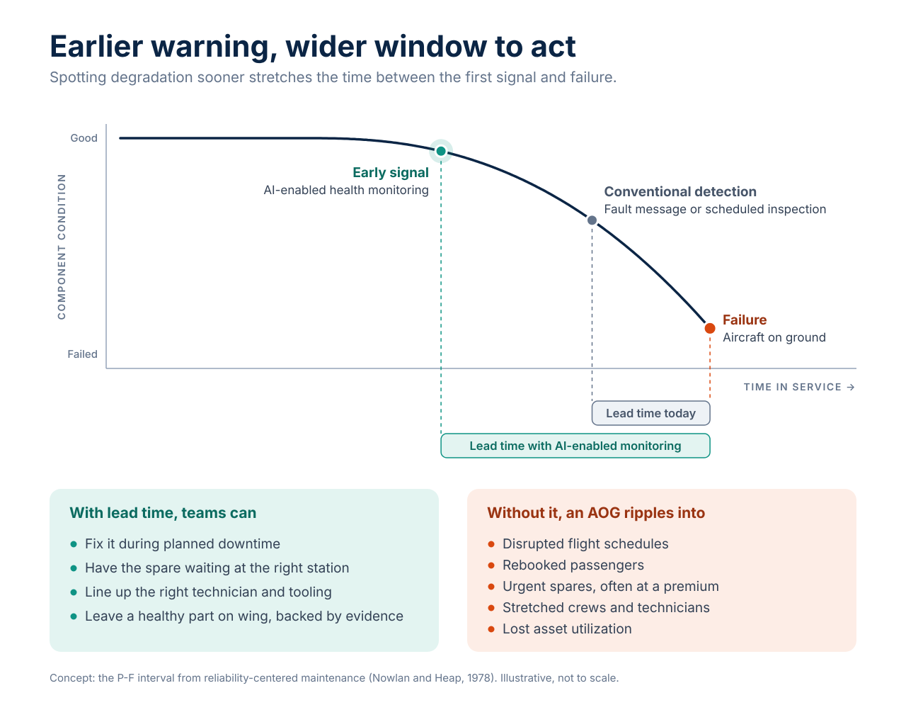
Figure 1. An earlier signal widens the window to act. Concept adapted from the P-F interval in reliability-centered maintenance.

How Aircraft Health Monitoring Converts Data into Actionable Signals

Modern aircraft ecosystems, while flush with data, continue to lack adequate signals. A sensor reading or fault code on its own says little. Read against operating conditions, past maintenance, component history, and the same part's behavior across the fleet, it can say a lot. That makes aircraft health monitoring the foundation of predictive MRO. Patterns emerge across systems and aircraft, so anomalies that once preceded a failure become an early warning when they reappear elsewhere.

For OEMs and Tier 1 suppliers, that in-service evidence also feeds reliability engineering, product improvement, and future design. What we learn from an aircraft in service should help us engineer the next one better.

From Predictive to Prescriptive Aircraft Maintenance with Digital Twins

An alert still leaves an engineer with questions. How urgent is it? How much useful life is left? When should we step in, and what happens if we defer? 

Here, digital twins help by joining an asset's engineering definition with its real operating history, usage, environment, inspection data, and maintenance record. The bigger opportunity is to take that thinking from the component to the operation. A maintenance call rarely turns on component health alone. Flight schedules, hangar capacity, technician availability, tooling, spares, and supply-chain lead times all weigh in, and right now they weigh heavily. IATA estimates supply chain problems cost airlines more than $11 billion in 2025, much of it in maintenance, engine leasing, and spares. Connect that context to predictive intelligence and you move toward prescriptive maintenance. 

The question shifts from what needs attention to when and how to act with the least operational impact.
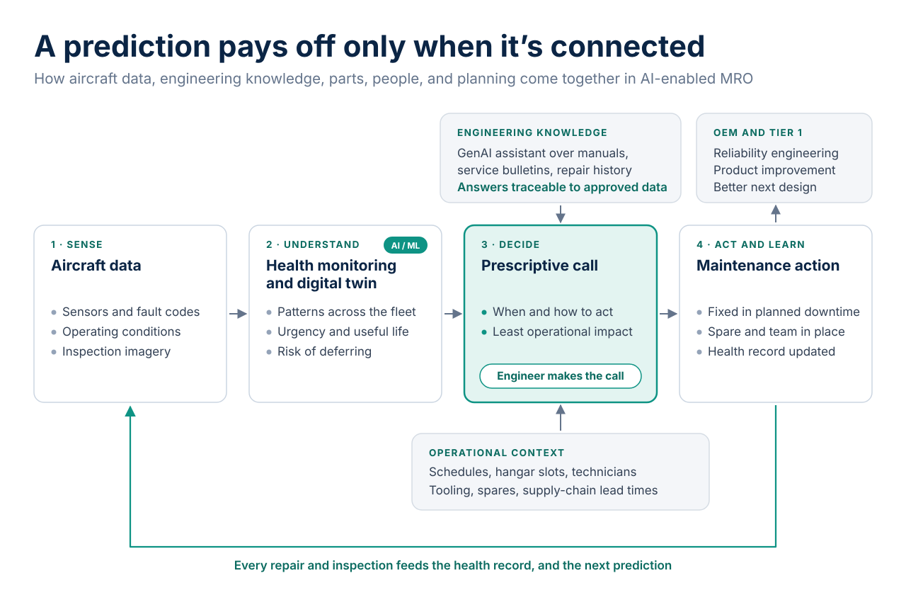
 

Figure 2. AI-enabled MRO as a connected loop: aircraft data, engineering knowledge, and operational context meet at the maintenance decision.

How AI-Powered Aircraft Inspections Build a Digital Maintenance Record

Visual inspection will stay fundamental, and so will the judgment of an experienced engineer or technician. Technology can make that judgment better informed. Computer vision, drones, high-resolution imaging, and robotics can find and document dents, cracks, corrosion, and other surface damage. Delta, for one, now uses drones to photograph aircraft after lightning strikes, with technicians assessing the images before release to service.

The larger payoff is keeping that record digitally. A technician can compare the same panel across maintenance cycles, see whether a defect is growing, and relate it to past repairs and operating conditions. The inspection stops being a one-off event. It becomes part of the aircraft's health record and another input to the next decision.

How GenAI Helps Aircraft Maintenance Engineers Access Trusted Knowledge

Not every MRO problem is a prediction problem. Sometimes the hard part is finding the right information fast enough. Engineers work across maintenance manuals, service bulletins, engineering orders, troubleshooting guides, repair histories, regulatory requirements, and years of experience held mostly in people's heads. The answer to a stubborn fault may already be in there somewhere.

This is where GenAI could earn its place. Take a technician on a night shift, chasing an intermittent fault. The questions are simple. Have we seen these symptoms before? What fixed them? Which approved data applies? A domain-grounded assistant could make those answers far quicker to reach.

But aerospace sets a high bar. A plausible answer is not good enough – it has to be traceable to trusted engineering sources, properly governed, and kept under human oversight, which is the line regulators are drawing too (EASA, FAA). 

The application of GenAI should therefore sharpen engineering judgment, not replace it.

Building a Connected AI-Enabled Aircraft MRO Ecosystem

A warning only matters if it arrives with enough distance left to act. In MRO, that means bringing aircraft data, engineering know-how, parts, people, and planning together, so teams make the right call before an issue becomes a disruption. At LTTS, that is how we see Engineering Intelligence helping maintenance move from reactive to predictive, and ultimately to more proactive decision-making.

Three things to take away

  • An unplanned AOG costs more than the repair. It hits schedules, passengers, spares, crews, and asset utilization.

  • The real value of predictive maintenance is the lead time it creates for a better maintenance decision.

  • AI alone will not transform MRO. Lasting value comes from connecting aircraft data with engineering knowledge, parts, people, and planning.


Relevant Blogs

Scaling AI Adoption in Aerospace Engineering
Beyond Efficiency: Smart Factories As Aerospace’s Next Competitive Advantage
Beyond Automation: How AI is Transforming Test Engineering for Aerospace into Engineering Intelligence
Explore All

Stay Relevant With Us

Subscribe to our blogs

 Sunil Prasad
Sunil Prasad

Global Head - Aerospace and Rail

Sunil Prasad brings over 28 years of leadership in Aerospace & Rail engineering, currently overseeing global delivery with 2,000+ engineers and driving profitable growth as Chief Executive of L&T Thales JV. An alumnus of IIM Calcutta in Business Management, he combines sharp business acumen with deep engineering expertise. His track record spans digital transformation, cybersecurity for safety-critical systems, and partnerships such as Airbus Skywise. A certified PgMP & PMP, Sunil has led multi-disciplinary programs worldwide, delivering innovations in avionics, inflight connectivity, and AI/ML-powered rail solutions. He also represented India in drafting DO-178C standards and contributes actively to industry forums.


Footer Navigation
  • Industry
    • Mobility
      • Aerospace
      • Automotive
      • Railway
      • Trucks & Off-Highway Vehicles
    • Sustainability
      • Discrete Manufacturing & Industrial Products
      • Process Manufacturing
    • Tech
      • Data Centers
      • Consumer Electronics
      • MedTech
      • Media & Entertainment
      • NexGen Comms
      • Semiconductors
      • Software & Platforms
      • Public Infrastructure & Smart Cities
  • Services
    • Digital Engineering
      • Artificial Intelligence
      • Cybersecure
      • Security Monitoring
      • Security Operation Center
      • Security Solutions
      • Security Services
      • EI Readiness Advisory
      • Immersive Experiences
      • Industry 4.0
      • Private Equity
      • Product Consulting
      • Sustainability Engineering
      • Sustainable Smart World
      • 5G
    • Product Engineering
      • CAE & CFD
      • CAx Automation
      • Software Engineering
      • Cloud Engineering
      • DevOps
      • Embedded Systems
      • Engineering Analytics
      • Integrated Design, Validation & Testing
      • Lab as a Service
      • Sustenance
      • Testing
      • Testing & Validation
      • User Experience
      • VLSI
      • Voice Innovations
      • Wearables Engineering
    • Manufacturing Engineering
      • Accelerated Operations
      • Digital Factory & Simulations
      • Line Expansion & Transfer
      • PLM on Cloud
      • Plant Design & Engineering
      • Sourcing & Procurement
    • Plant Engineering
      • CAPEX Project E/EPCM Services
      • Material & Parts Management
      • Operational Excellence
      • Plant Sustenance & Management
      • Sourcing & Procurement
      • Regulatory Compliance Engineering
  • Engineering Intelligence
  • Careers
  • Engineering The Change
  • Resources
  • Engineer at Heart
  • Solutions
    • Ainfonix™
    • AiStudio
    • Asset Health Framework
    • EIOne
    • EnergiSensEI
    • Lights-out Factory
    • LTwin
    • PLxAI
    • QAssure.ai
    • VirtualNEXUS™
    • View all Solutions
  • About Us
    • Accolades
    • Alliances
    • Board of Directors
    • Innovations
    • Investors
    • Nearshore Centers
    • Testimonials
LTTS
  •  Twitter
  •  LinkedIn
  •  YouTube
  •  Facebook
  •  Instagram
  • Copyright & Terms
  • Privacy
  • Sitemap
  • info@ltts.com

© 2026 L&T Technology Services Limited. All Rights Reserved.