Published on 20 Jul 2026
min read
Views
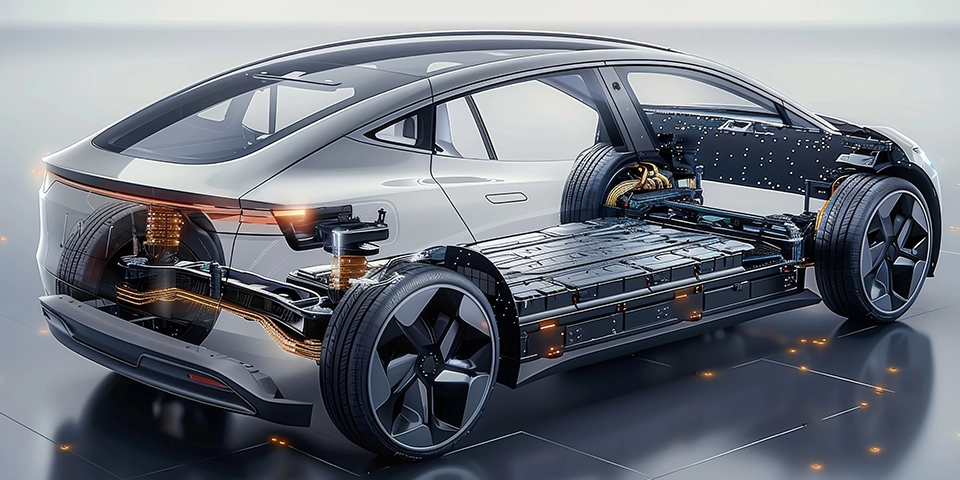
What happens to an EV battery when nobody is thinking about it?
An EV battery can continue experiencing environmental and thermal stress even when the vehicle is parked or charging. SmartBatt AI is an LTTS engineering framework designed to explore how environmental intelligence, physics-guided modelling and AI-based prediction can work together to support proactive EV battery thermal management.
Almost every conversation about an electric vehicle centres on charging speed, driving range, and safety parameters. However, a major yet critical dimension is often overlooked: what happens to the battery when the vehicle is parked.
Despite the freedom that it provides, a modern EV spends a significant share of its life stationary outside homes, at airports, on logistics hub tarmacs, in public parking structures. While the vehicle idles, heat accumulation inside the battery pack does not.
An early 2026 study analyzing over 22,700 EVs found that batteries degrade at an average rate of 2.3% per year, with EVs in hot climates degrading roughly 0.4% faster annually than those in milder conditions. Again, batteries exposed to sustained temperature extremes can lose 20-40% of their total capacity over time. This annual number may look small in isolation, but compounded across a vehicle’s lifecycle, it shapes battery longevity, warranty costs, maintenance planning, residual value, and customer satisfaction.
This raises a simple engineering question: if modern vehicles can already predict traffic conditions, optimize energy consumption, and learn continuously from operational data, why are battery systems still largely reacting to heat-related stress after it has already occurred?
That question is the starting point for SmartBatt AI.
What Is the Thermal Visibility Gap?
Today’s Battery Management Systems (BMS) are highly effective during active operations — tracking temperature, voltage, current, and safety limits in real time while a vehicle charges or drives. The typical protective logic is straightforward, exceeding the temperature threshold initiates cooling activates across engaging pre-engineered protection measures.
This paradigm works well for preventing acute thermal events, but battery aging is rarely the result of a single event. It develops gradually, through repeated exposure to heat over months and years — often while the battery stays well within its normal operating limits the entire time.
A vehicle parked under direct sun for hours continues absorbing heat long after any threshold-based system would have reason to react – silently accelerating electrolyte degradation and increasing internal impedance.
The issue, therefore, is not that today’s systems lack protection, but rather that they have a limited window into what happens next. We know the battery’s current condition well – far less about how the next several hours or days of environmental exposure will shape its long-term health. This is the Thermal Visibility Gap, underscoring the thermal-blind operating phase that most BMS architectures were never designed to see.
Reactive vs. Predictive Battery Thermal Management
As vehicles evolve into software-defined platforms, the expectation for battery intelligence is rising with them. Instead of only asking "What is the battery temperature right now?", future battery platforms need to ask, "How is this battery likely to behave over the next several hours or days, and what can be done today to improve its long-term health?"
This represents the shift from reactive battery protection to predictive battery thermal management.
This is the engineering direction SmartBatt AI explores — not as a replacement for existing BMS architecture, but as an additional intelligence layer built specifically for the conditions that existing BMS were not designed to anticipate: prolonged parking, overnight charging, and extended idle exposure.
How SmartBatt AI Works?
SmartBatt AI is structured around five core pillars:
- Environmental Intelligence, with real-time and forecast ambient data ingestion,
- Virtual Thermal Digital Twin, with physics-guided simulation of the battery thermal state,
- Physics-Guided Thermal Prediction, with electrochemical and thermodynamic modeling,
- Predictive Thermal Cognition, with AI-driven anticipation of thermal stress windows, and
- Battery Health Passport, with continuous lifecycle documentation and degradation tracking.
Together, these pillars help shift the operating question from what happened to the battery to what is likely to happen to it next? The objective here is to refocus around foresight.
Potential Thermal-Mitigation Strategies
One of the more compelling elements of the framework is how it evaluates mitigation. Rather than activating physical cooling only after thermal escalation, SmartBatt AI tests mitigation strategies inside a virtual thermal environment first — before physical stress intensifies. Strategies simulated within this layer include:
- Cooling strategy scheduling and pre-activation,
- Airflow and ventilation management optimization,
- Charging rate moderation based on predicted thermal load,
- Thermal load redistribution across battery modules, and
- Auxiliary thermal-control system adjustments.
And the payoff is evident across more accurate predictive thermal management, with minimal thermal-control activation — extending component life while lowering energy consumption.
Why should OEMs and Fleet Operators Care?
Battery packs remain one of the most valuable components in an EV, and even a modest improvement in thermal-health prediction carries outsized value.
For OEMs, improved visibility could support:
- Better warranty forecasting
- Enhanced customer confidence
- Improved battery lifecycle management
- More informed product-development decisions
For fleet operators, predictive thermal intelligence could help:
- Reduce unexpected battery-related downtime
- Improve vehicle availability
- Optimize maintenance planning
- Lower total cost of ownership
For sustainability programs, it may support:
- Battery second-life evaluation
- Residual-value estimation
- Circular-economy initiatives
- More informed end-of-life decisions
Predictive battery intelligence, therefore, promises to unlock extensive benefits across the value chain.
Supporting Battery Passport Readiness
As the global battery ecosystem moves toward greater lifecycle transparency, digital battery records are becoming increasingly important.
How does a battery health passport work? It continuously records battery performance, usage history, degradation patterns, and lifecycle data, enabling greater transparency for manufacturers, fleet operators, regulators, and second-life applications.
The EU Battery Regulation makes digital battery passports mandatory starting February 2027 – there is a clear demand for cell-level battery passport systems. KIA has already become the first European automaker to pilot such a system in 2025, underscoring the needs for a SmartBatt AI-enabled Battery Health Passport for continuously evolving digital record tracking.
The mandate is clear.
Conclusion
EV battery intelligence must move from reactive protection to predictive foresight. Thermal stress builds quietly during parking, charging, and extended idle exposure — shaping degradation, warranty risk, vehicle availability, and lifecycle value. SmartBatt AI helps anticipate that risk before it becomes a cost.
Explore how LTTS can help your organisation build predictive battery health and thermal management capabilities for the next generation of electric vehicles.
Contact our mobility engineering experts.