

Executive Summary
A leading automotive OEM sought to accelerate door-system validation by reducing the manual effort involved in clearance measurement and compliance verification. LTTS engineered an AI-powered validation platform that transforms CAD-based clearance checks into an intelligent, automated decision-making process, enabling faster and more consistent design validation.
Read the Full Case Study. Anytime, Anywhere
Download Case StudyThe Challenge
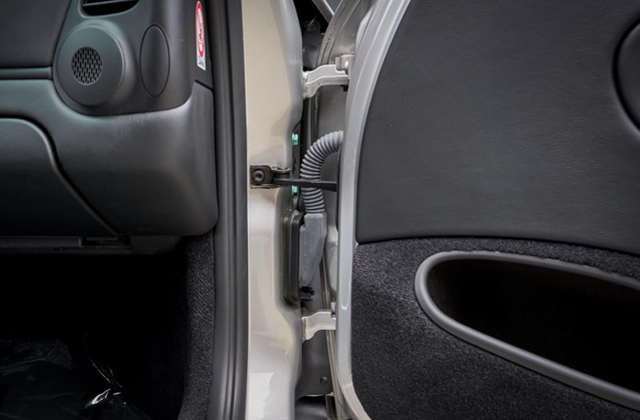
Door hinge clearance validation is one of the most critical activities in automotive door-system design. Engineers must verify clearances between hinges, door panels, pillars, and adjacent structures across multiple opening positions to ensure manufacturability, durability, and performance. Traditionally, this required manually generating CAD sections, extracting measurements, interpreting engineering standards, and documenting outcomes. As design complexity and iteration cycles increased, validation became a time-consuming and error-prone engineering bottleneck.
Engineering Complexity
Both problems are hard for reasons that do not show up in a demo.

Critical design knowledge existed across multiple sources including CAD sections, clearance measurements, layout check sheets, and engineering standards.

Validation required both visual and contextual interpretation. Engineers had to understand measurements captured within CAD images and correlate them with hinge-specific design requirements.

Manual verification limited scalability. Hundreds of clearance checkpoints across multiple design iterations created significant effort and risk of inconsistency.

Objective and repeatable decision-making was essential. Validation outcomes needed to be standardized across vehicle programs while maintaining traceability to engineering requirements.

Automated Clearance Validation Workflow
Integrated CAD APIs to automatically generate hinge section views and identify critical clearance checkpoints across door operating conditions, eliminating repetitive manual CAD activities.

AI-Powered Engineering Data Extraction
Applied OCR and intelligent data processing to extract clearance dimensions, component relationships, and engineering annotations directly from CAD-generated images.

Engineering Requirement Interpretation
Leveraged vector embeddings to digitize engineering standards, SOPs, and clearance requirements, enabling contextual comparison between measured values and design expectations.

Intelligent Compliance Assessment
Developed an AI decision engine capable of automatically evaluating design compliance and classifying clearance checkpoints as OK / NOT OK based on engineering intent rather than simple rule matching.

Synthetic Data Enablement
Developed synthetic datasets to overcome restricted access to proprietary design data, enabling effective validation, testing, and reliable engineering outcomes while preserving data confidentiality.

Automated Validation Reporting
Repeating Generated standardized layout verification reports, reducing dependence on manual check sheets while improving consistency across design programs.

Scalable Validation Framework
Built reusable AI and automation components that can be extended beyond hinge validation to additional packaging, clearance, and design verification use cases.

AI-Driven Engineering Insights
Provided contextual recommendations on design approaches, material selection, design iterations, and BOM considerations, helping engineers make faster and more informed design decisions.
Business Outcomes
Up to 80%
Reduction in manual validation efforts
By automating measurement extraction, interpretation, and compliance verification activities.
Scalable foundation for intelligent design validation
That can be extended across vehicle systems and future engineering programs.
Accelerated design cycles
Through faster clearance validation and immediate feedback across design iterations.
Improved engineering accuracy and consistency
Through objective AI-driven validation aligned to engineering standards.
The EI Edge
LTTS transformed door-system validation from a measurement-driven process into an intelligence-driven engineering capability. By combining CAD automation with AI-powered interpretation of engineering requirements, the solution automatically evaluated compliance, delivered objective validation outcomes, and reduced reliance on manual reviews.
Beyond accelerating validation cycles, the solution established a scalable Engineering Intelligence foundation that can be extended across packaging validation, design compliance, and future vehicle engineering programs.
Success Stories
Unified Vehicle Data Platform for Connected Mobility
Discover how LTTS unified connected-vehicle data across brands, enabling secure access, commercial data products, partner integration, and scalable mobility services.
Know More