


Executive Summary
A global MedTech OEM was one test away from shipping. Its medical grade power supply kept throwing a false buzzer indication at the EMC bench under conducted and radiated immunity, leaving a Class II (FDA) and Class I (EU MDR) device short of the certification it needed to reach patients. LTTS rebuilt the electrical architecture from first principles and carried it from concept to manufacturing transfer, clearing full IEC 60601-1 and 60601-1-2 compliance while cutting product cost by 90 percent.
Read the Full Case Study. Anytime, Anywhere
Download Case StudyClient Challenge
A false buzzer indication at the EMC bench is an unshippable failure mode. No certification, no launch, no revenue, and every downstream date slides with it. Redesigning the failing board would have moved the symptom, not removed it: the pulse width modulation generating circuit sat outside the power supply, creating noise coupling paths shielding could not contain. All the while, the OEM was squeezed from three directions at once, miniaturization, patient safety and cost. They did not need a fix. They needed a rebuilt electrical architecture that would clear compliance cleanly and open commercial ground the product could not previously reach
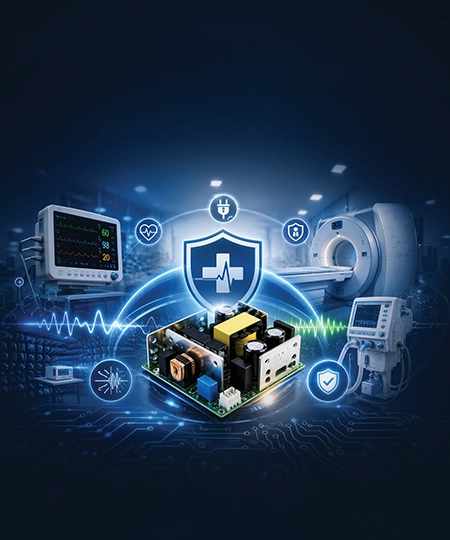
Engineering Complexity - Why It Was Hard
EMC failures are rarely where the test report points.
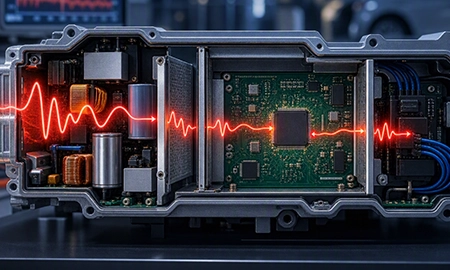
The noise path was architectural, not local
With PWM generation outside the supply, switching noise had a route shielding could only attenuate. Closing it meant moving a function across a boundary, which resets the thermal, layout and isolation picture at once
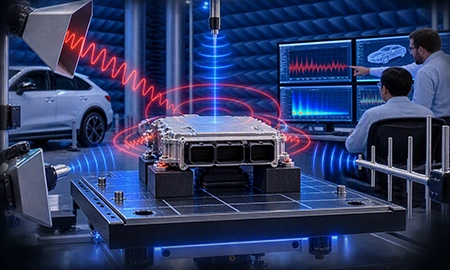
Immunity testing punishes assumptions
It applies energy the designer did not choose, in a coupling mode the designer did not plan for. A layout that passes emissions can still fail immunity, and it surfaces as odd behavior rather than a clean fault.

Cost and compliance pull opposite ways
Every conventional route to EMC margin adds filtering, shielding and copper. A 90 percent cost reduction meant the savings had to come from architecture, not component substitution.
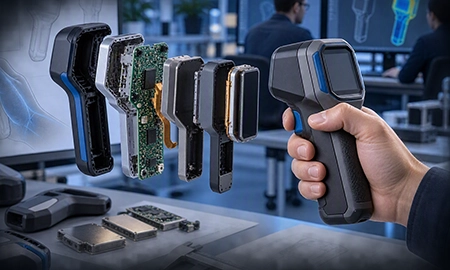
Usability set the envelope
The device had to work one handed, which fixes the mechanical boundary before the electronics get a vote on separation.

Architecture rebuilt around the noise source
PWM generation was brought inside the power supply, removing the coupling path at its origin.

PCB stack up engineered for immunity
Stack up, return paths and separation designed against the failure mode, so compliance became a property of the design rather than the shielding budget

CM qualification across four geographies
India, USA, Mexico and Singapore, so the OEM ended the program with sourcing flexibility, not a single dependency.

Industrial design for single hand operation
Enclosure and interaction model engineered alongside the electronics, keeping usability out of late stage compromise

PCBA, tooling and product qualification
Developed and qualified with the CM, so transfer did not become a second engineering cycle.

DVT owned end to end
Protocols, execution and reporting for functional, transit (ASTM D4169 and F2825), wipe and one year equivalent reliability testing, structured for regulatory submission
Business Outcomes
90%
Lower product cost
From removing an architectural workaround and its mitigation hardware, which is why compliance improved at the same time.
Full IEC 60601-1 and 60601-1-2 compliance
With the buzzer fault eliminated at design level rather than suppressed.
4
Geography CM footprint qualified
Giving the OEM sourcing resilience and negotiating position.
1
Year equivalent electrical life validated
Alongside ASTM transit qualification, so reliability claims sit on executed protocols.
Success Stories
Transforming Medical Device Performance for Healthier Outcomes
The need to improve charge time, increase safety, and gain better visibility of battery charging needs demanded a rigorous testing and monitoring solution.
Know More